Ch.10 - Gases
Brown - Chemistry: The Central Science 14th Edition
Brown14th EditionChemistry: The Central ScienceISBN: 9780134414232Non è quello che usi tu?Cambia libro di testo
Capitolo 10, Problema 98

A gas bubble with a volume of 1.0 mm3 originates at the bottom of a lake where the pressure is 3.0 atm. Calculate its volume when the bubble reaches the surface of the lake where the pressure is 730 torr, assuming that the temperature does not change.

Guida verificata passo dopo passo
1
Step 1: Convert the given pressures into the same units. Since 1 atm = 760 torr, the pressure at the bottom of the lake is 3.0 atm * 760 torr/atm = 2280 torr.
Step 2: Use the ideal gas law in the form P1V1 = P2V2, where P1 and V1 are the initial pressure and volume, and P2 and V2 are the final pressure and volume. This equation is valid because the temperature and the amount of gas are constant.
Step 3: Substitute the given values into the equation. P1 = 2280 torr, V1 = 1.0 mm^3, and P2 = 730 torr. Solve for V2.
Step 4: Rearrange the equation to solve for V2: V2 = (P1V1) / P2.
Step 5: Substitute the values into the equation to find the volume of the gas bubble when it reaches the surface of the lake.

Risposta video verificata per un problema simile:

Questa soluzione video è stata consigliata dai nostri tutor come utile per risolvere questo problema.
Durata del video:
2m

Concetti chiave

Ecco i concetti essenziali che devi comprendere per rispondere correttamente alla domanda.

Ideal Gas Law

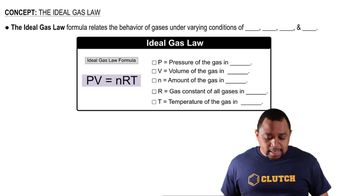
The Ideal Gas Law relates the pressure, volume, temperature, and number of moles of a gas through the equation PV = nRT. In this scenario, while the temperature remains constant, the law helps us understand how changes in pressure affect the volume of a gas bubble as it rises.
Video consigliato:
Percorso guidato
01:15
Ideal Gas Law Formula

Boyle's Law

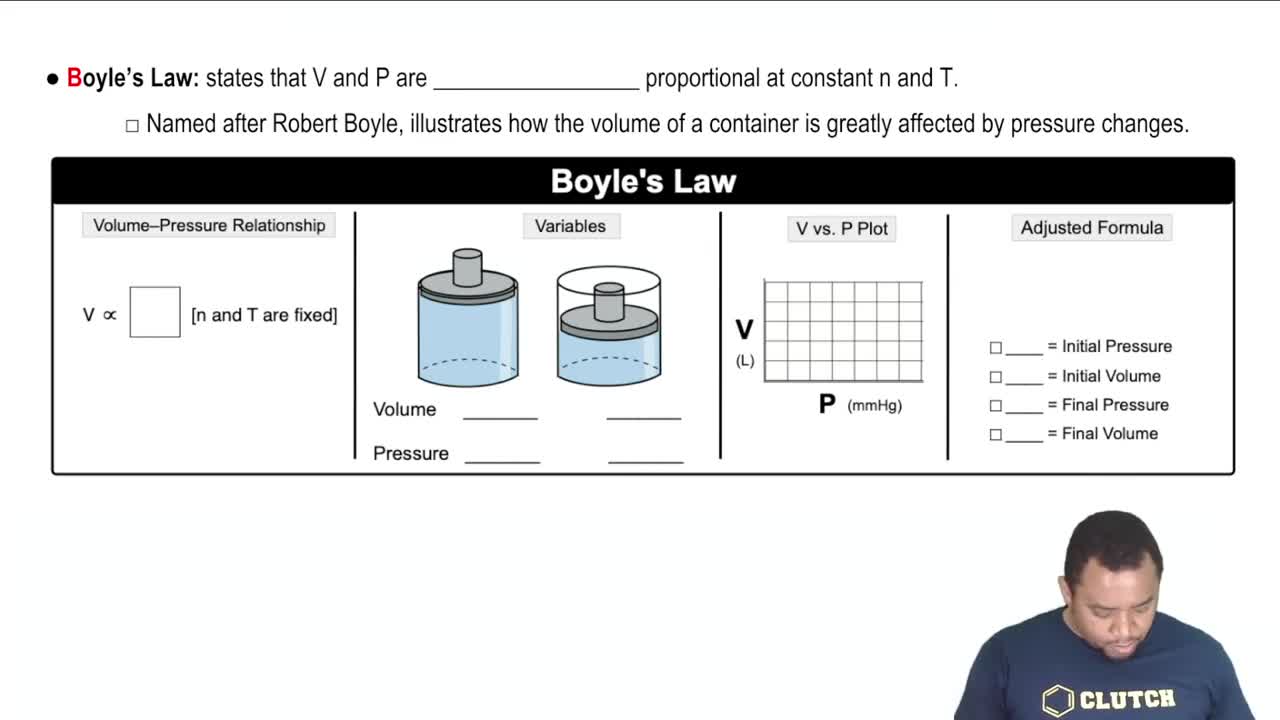
Boyle's Law states that the pressure of a gas is inversely proportional to its volume when temperature is held constant (P1V1 = P2V2). This principle is crucial for solving the problem, as it allows us to calculate the new volume of the gas bubble at a different pressure.
Video consigliato:

Unit Conversion

Unit conversion is essential in this problem because the initial pressure is given in atmospheres (atm) and the final pressure in torr. Understanding how to convert between these units (1 atm = 760 torr) ensures accurate calculations when applying gas laws.
Video consigliato:
Percorso guidato
01:56
Conversion Factors
Pratica correlata
Domanda del libro di testo

Calculate the pressure that CCl4 will exert at 80 °C if 1.00 mol occupies 33.3 L, assuming that (c) Which would you expect to deviate more from ideal behavior under these conditions, Cl2 or CCl4? Explain.

Domanda del libro di testo

Carbon dioxide, which is recognized as the major contributor to global warming as a “greenhouse gas,” is formed when fossil fuels are combusted, as in electrical power plants fueled by coal, oil, or natural gas. One potential way to reduce the amount of CO2 added to the atmosphere is to store it as a compressed gas in underground formations. Consider a 1000-megawatt coal-fired power plant that produces about 6⨉106 tons of CO2 per year. (b) If the CO2 is stored underground as a liquid at 10 C and 12.16 MPa and a density of 1.2 g/cm3, what volume does it possess?

1
views
Domanda del libro di testo

Carbon dioxide, which is recognized as the major contributor to global warming as a 'greenhouse gas,' is formed when fossil fuels are combusted, as in electrical power plants fueled by coal, oil, or natural gas. One potential way to reduce the amount of CO2 added to the atmosphere is to store it as a compressed gas in underground formations. Consider a 1000-megawatt coal-fired power plant that produces about 6×10⁶ tons of CO2 per year. (a) Assuming ideal-gas behavior, 101.3 kPa, and 27 °C, calculate the volume of CO2 produced by this power plant.

970
views
Domanda del libro di testo

Table 10.3 shows that the van der Waals b parameter has units of L/mol. This means that we can calculate the sizes of atoms or molecules from the b parameter. Refer back to the discussion in Section 7.3. Is the van der Waals radius we calculate from the b parameter of Table 10.3 more closely associated with the bonding or nonbonding atomic radius discussed there? Explain.

1152
views
Domanda del libro di testo
Torricelli, who invented the barometer, used mercury in its construction because mercury has a very high density, which makes it possible to make a more compact barometer than one based on a less dense fluid. Calculate the density of mercury using the observation that the column of mercury is 760 mm high when the atmospheric pressure is 1.01 * 105 Pa. Assume the tube containing the mercury is a cylinder with a constant cross-sectional area.
816
views