
Ch.10 - Gases
Brown - Chemistry: The Central Science 14th Edition
Brown14th EditionChemistry: The Central ScienceISBN: 9780134414232Non è quello che usi tu?Cambia libro di testo
Capitolo 10, Problema 96

Table 10.3 shows that the van der Waals b parameter has units of L/mol. This means that we can calculate the sizes of atoms or molecules from the b parameter. Refer back to the discussion in Section 7.3. Is the van der Waals radius we calculate from the b parameter of Table 10.3 more closely associated with the bonding or nonbonding atomic radius discussed there? Explain.

Guida verificata passo dopo passo
1
Identify the van der Waals b parameter, which accounts for the volume occupied by gas molecules and is expressed in units of L/mol.
Understand that the van der Waals b parameter is related to the size of the molecules, as it represents the excluded volume per mole of molecules.
Recall that the van der Waals radius is a measure of the size of an atom or molecule when it is not bonded to another atom, reflecting the space it occupies due to electron cloud repulsion.
Compare the van der Waals radius with the bonding atomic radius, which is typically smaller because it represents the distance between nuclei in a bonded state, where electron clouds overlap.
Conclude that the van der Waals radius calculated from the b parameter is more closely associated with the nonbonding atomic radius, as it reflects the size of the molecule when not involved in bonding.

Risposta video verificata per un problema simile:

Questa soluzione video è stata consigliata dai nostri tutor come utile per risolvere questo problema.
Durata del video:
1m

Concetti chiave

Ecco i concetti essenziali che devi comprendere per rispondere correttamente alla domanda.

van der Waals b parameter

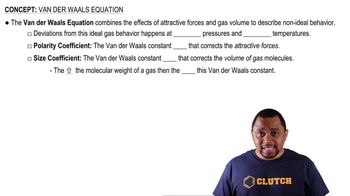
The van der Waals b parameter represents the volume occupied by one mole of particles in a gas, accounting for the finite size of the molecules. It is a crucial factor in the van der Waals equation, which describes real gas behavior by incorporating molecular interactions and sizes. The b parameter helps in estimating the effective size of atoms or molecules, which is essential for understanding intermolecular forces.
Video consigliato:
Percorso guidato
01:40
Van der Waals Equation

van der Waals radius

The van der Waals radius is a measure of the size of an atom or molecule when it is not bonded to another atom. It reflects the distance at which the electron clouds of two nonbonding atoms begin to overlap, indicating the effective size of the atom in a nonbonding context. This radius is important for understanding molecular interactions, particularly in gases and liquids where atoms are not held together by covalent bonds.
Video consigliato:
Percorso guidato
01:40
Van der Waals Equation

bonding vs. nonbonding atomic radius

Bonding atomic radius refers to the size of an atom when it is involved in a chemical bond, typically smaller due to the influence of electron sharing or transfer. In contrast, nonbonding atomic radius, such as the van der Waals radius, describes the size of an atom when it is not participating in bonding interactions. Understanding the distinction between these radii is essential for interpreting molecular structures and interactions in various states of matter.
Video consigliato: