Ch.10 - Gases
Brown - Chemistry: The Central Science 14th Edition
Brown14th EditionChemistry: The Central ScienceISBN: 9780134414232Non è quello che usi tu?Cambia libro di testo
Capitolo 10, Problema 113f

Consider the following gases, all at STP: Ne, SF6, N2, CH4. (f) Which one would effuse more rapidly than N2?

Guida verificata passo dopo passo
1
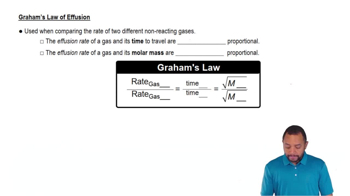
Identify the concept of effusion and relate it to Graham's law, which states that the rate of effusion of a gas is inversely proportional to the square root of its molar mass.
List the molar masses of the given gases: Ne (Neon), SF_6 (Sulfur hexafluoride), N_2 (Nitrogen), and CH_4 (Methane).
Calculate the molar mass of each gas: Ne = 20.18 g/mol, SF_6 = 146.06 g/mol, N_2 = 28.02 g/mol, CH_4 = 16.04 g/mol.
Compare the molar masses of the gases to that of N_2. According to Graham's law, a gas with a lower molar mass than N_2 will effuse more rapidly.
Determine which gas has a molar mass less than that of N_2 and conclude that this gas will effuse more rapidly than N_2.

Risposta video verificata per un problema simile:

Questa soluzione video è stata consigliata dai nostri tutor come utile per risolvere questo problema.
Durata del video:
1m

Concetti chiave

Ecco i concetti essenziali che devi comprendere per rispondere correttamente alla domanda.

Graham's Law of Effusion

Graham's Law states that the rate of effusion of a gas is inversely proportional to the square root of its molar mass. This means that lighter gases effuse more quickly than heavier gases. For example, if comparing nitrogen (N2) with other gases, the gas with a lower molar mass than nitrogen will effuse more rapidly.
Video consigliato:
Percorso guidato
2:03
Graham's Law of Effusion

Molar Mass

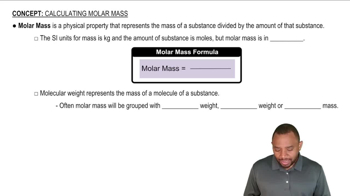
Molar mass is the mass of one mole of a substance, typically expressed in grams per mole (g/mol). It is a critical factor in determining the rate of effusion according to Graham's Law. In this context, knowing the molar masses of Ne, SF6, N2, and CH4 allows us to predict which gas will effuse faster than nitrogen.
Video consigliato:
Percorso guidato
02:11
Molar Mass Concept

Standard Temperature and Pressure (STP)

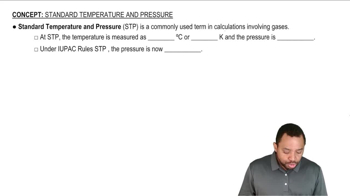
Standard Temperature and Pressure (STP) is defined as a temperature of 0 degrees Celsius (273.15 K) and a pressure of 1 atmosphere (atm). At STP, the behavior of gases can be compared more easily, as their properties are standardized. This context is essential for analyzing the effusion rates of the gases mentioned in the question.
Video consigliato:
Percorso guidato
01:08
Standard Temperature and Pressure