
Ch.10 - Gases
Brown - Chemistry: The Central Science 14th Edition
Brown14th EditionChemistry: The Central ScienceISBN: 9780134414232Non è quello che usi tu?Cambia libro di testo
Capitolo 10, Problema 6a

The apparatus shown here has two gas-filled containers and one empty container, all attached to a hollow horizontal tube. When the valves are opened and the gases are allowed to mix at constant temperature, what is the distribution of atoms in each container?
Diagram showing gas containers in a setup for studying effusion in gases.

Guida verificata passo dopo passo
1
Identify the initial conditions: three containers with different gases (red, blue, green) and two empty containers.
Recognize that when the valves are opened, the gases will mix and distribute evenly due to diffusion.
Understand that the total number of gas particles will be conserved, and they will spread out to occupy all available space.
Calculate the total number of gas particles from all containers and divide by the number of containers to find the average number of particles per container.
Conclude that each container will have an equal number of gas particles, with a mix of red, blue, and green particles in each container.

Risposta video verificata per un problema simile:

Questa soluzione video è stata consigliata dai nostri tutor come utile per risolvere questo problema.
Durata del video:
3m

Concetti chiave

Ecco i concetti essenziali che devi comprendere per rispondere correttamente alla domanda.

Gas Laws

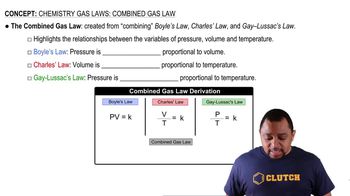
Gas laws describe the behavior of gases under various conditions of temperature, pressure, and volume. Key laws include Boyle's Law, Charles's Law, and Avogadro's Law, which collectively explain how gas volume changes with pressure and temperature. Understanding these laws is essential for predicting how gases will behave when allowed to mix or expand in a given system.
Video consigliato:
Percorso guidato
01:43
Combined Gas Law

Effusion and Diffusion

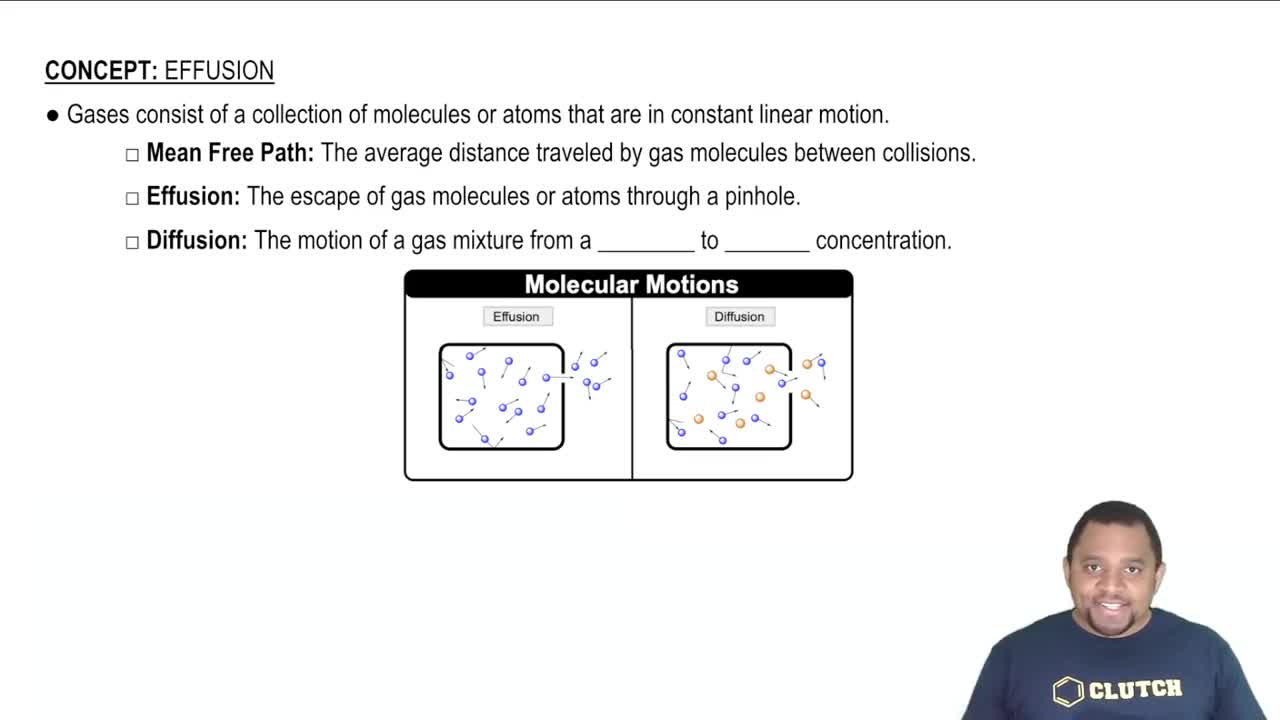
Effusion is the process by which gas molecules escape from a container through a small opening, while diffusion refers to the mixing of gas molecules due to their random motion. Graham's Law of Effusion states that the rate of effusion of a gas is inversely proportional to the square root of its molar mass. These concepts are crucial for understanding how gases will distribute themselves in the containers after the valves are opened.
Video consigliato:
Percorso guidato
02:33
Effusion vs Diffusion

Kinetic Molecular Theory

The Kinetic Molecular Theory explains the behavior of gases in terms of particle motion. It posits that gas particles are in constant, random motion and that their collisions with container walls create pressure. This theory helps to understand how temperature affects the speed of gas particles and, consequently, the distribution of gases in the containers when mixed.
Video consigliato:
Percorso guidato
01:19
Kinetic Molecular Theory