

Ch.10 - Gases
Brown - Chemistry: The Central Science 14th Edition
Brown14th EditionChemistry: The Central ScienceISBN: 9780134414232Non è quello che usi tu?Cambia libro di testo
Capitolo 10, Problema 4

Imagine that the reaction 2 CO1g2 + O21g2¡2 CO21g2 occurs in a container that has a piston that moves to maintain a constant pressure when the reaction occurs at constant temperature. Which of the following statements describes how the volume of the container changes due to the reaction: (a) the volume increases by 50%, (b) the volume increases by 33%, (c) the volume remains constant, (d) the volume decreases by 33%, (e) the volume decreases by 50%.

Guida verificata passo dopo passo
1
Step 1: Identify the number of moles of gas on both sides of the reaction. In the given reaction, 2 CO(g) + O2(g) -> 2 CO2(g), there are 3 moles of gas on the reactant side (2 moles of CO and 1 mole of O2) and 2 moles of gas on the product side (2 moles of CO2).
Step 2: Understand that the volume of a gas is directly proportional to the number of moles of the gas, according to Avogadro's law. This means that if the number of moles of gas decreases, the volume of the gas will also decrease.
Step 3: Calculate the percentage change in the number of moles of gas. The reaction goes from 3 moles of gas to 2 moles of gas, which is a decrease of 1 mole. The percentage decrease is therefore (1/3)*100% = 33.33%.
Step 4: Apply this percentage change to the volume of the container. Since the volume of the container is directly proportional to the number of moles of gas, a 33.33% decrease in the number of moles of gas will result in a 33.33% decrease in the volume of the container.
Step 5: Therefore, the correct answer is (d) the volume decreases by 33%.

Risposta video verificata per un problema simile:

Questa soluzione video è stata consigliata dai nostri tutor come utile per risolvere questo problema.
Durata del video:
2m

Concetti chiave

Ecco i concetti essenziali che devi comprendere per rispondere correttamente alla domanda.

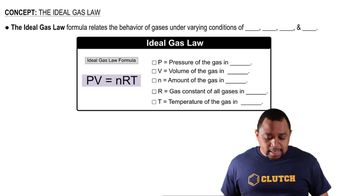
Ideal Gas Law

The Ideal Gas Law relates the pressure, volume, temperature, and number of moles of a gas through the equation PV = nRT. In this scenario, understanding how the number of moles of gas changes during the reaction is crucial, as it directly affects the volume of the gas at constant temperature and pressure.
Video consigliato:
Percorso guidato
01:15
Ideal Gas Law Formula

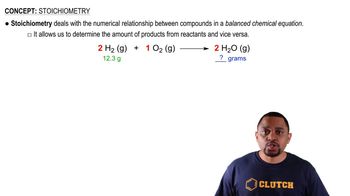
Stoichiometry

Stoichiometry involves the calculation of reactants and products in chemical reactions based on balanced equations. In this case, the balanced equation shows that 2 moles of CO react with 1 mole of O2 to produce 2 moles of CO2, indicating that the total number of moles of gas changes, which is essential for determining the volume change.
Video consigliato:
Percorso guidato
01:16
Stoichiometry Concept

Avogadro's Principle

Avogadro's Principle states that equal volumes of gases, at the same temperature and pressure, contain an equal number of molecules. This principle helps in understanding how the change in the number of moles of gas during the reaction affects the volume of the container, as the volume will adjust to maintain constant pressure and temperature.
Video consigliato:
Percorso guidato
02:05
Uncertainty Principle Formula