Ch.10 - Gases
Brown - Chemistry: The Central Science 14th Edition
Brown14th EditionChemistry: The Central ScienceISBN: 9780134414232Non è quello che usi tu?Cambia libro di testo
Capitolo 10, Problema 31

Suppose you are given two 2-L flasks and told that one contains a gas of molar mass 28, the other a gas of molar mass 56, both at the same temperature and pressure. The mass of gas in the flask A is 1.0 g and the mass of gas in the flask B is 2.0 g. Which flask contains the gas of molar mass 28, and which contains the gas of molar mass 56?

Guida verificata passo dopo passo
1
Identify the relationship between mass, molar mass, and moles using the formula: \( n = \frac{m}{M} \), where \( n \) is the number of moles, \( m \) is the mass, and \( M \) is the molar mass.
Recognize that both gases are at the same temperature and pressure, and in the same volume, so they have the same number of moles according to Avogadro's law.
Calculate the number of moles for each flask using the given masses and molar masses: \( n_A = \frac{1.0 \text{ g}}{28 \text{ g/mol}} \) for flask A and \( n_B = \frac{2.0 \text{ g}}{56 \text{ g/mol}} \) for flask B.
Compare the calculated moles for each flask. Since the number of moles should be the same, the flask with the correct number of moles will match the molar mass.
Determine which flask corresponds to which molar mass based on the calculated moles, identifying flask A or B with the gas of molar mass 28 or 56.

Risposta video verificata per un problema simile:

Questa soluzione video è stata consigliata dai nostri tutor come utile per risolvere questo problema.
Durata del video:
2m

Concetti chiave

Ecco i concetti essenziali che devi comprendere per rispondere correttamente alla domanda.

Ideal Gas Law

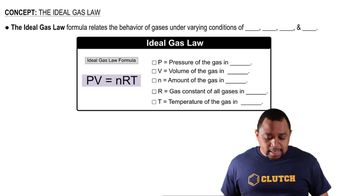
The Ideal Gas Law relates the pressure, volume, temperature, and number of moles of a gas through the equation PV = nRT. This law helps in understanding how gases behave under different conditions and is essential for determining the amount of gas present in a given volume at a specific temperature and pressure.
Video consigliato:
Percorso guidato
01:15
Ideal Gas Law Formula

Molar Mass and Density

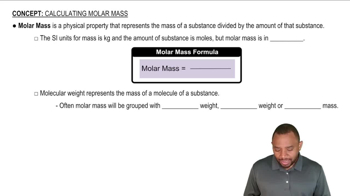
Molar mass is the mass of one mole of a substance, typically expressed in grams per mole (g/mol). The density of a gas can be calculated using its molar mass and the Ideal Gas Law, allowing us to relate the mass of gas in a flask to its volume and molar mass, which is crucial for solving the problem.
Video consigliato:
Percorso guidato
02:11
Molar Mass Concept

Mass and Moles Relationship

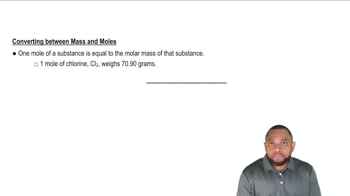
The relationship between mass, moles, and molar mass is given by the equation: mass = moles × molar mass. This concept is vital for determining how many moles of gas are present in each flask based on the given mass, enabling us to identify which gas corresponds to each molar mass.
Video consigliato:
Percorso guidato
02:28
Mass and Moles Conversion