
Ch.10 - Gases
Brown - Chemistry: The Central Science 14th Edition
Brown14th EditionChemistry: The Central ScienceISBN: 9780134414232Non è quello che usi tu?Cambia libro di testo
Capitolo 10, Problema 35

The Goodyear blimps, which frequently fly over sporting events, hold approximately 4955 m3 of helium. If the gas is at 23 °C and 101.33 kPa, what mass of helium is in a blimp?

Guida verificata passo dopo passo
1
Step 1: Use the Ideal Gas Law equation, PV = nRT, to find the number of moles (n) of helium. Here, P is the pressure (101.33 kPa), V is the volume (4955 m^3), R is the ideal gas constant (8.314 J/(mol·K)), and T is the temperature in Kelvin (23 °C + 273.15).
Step 2: Convert the pressure from kPa to Pa by multiplying by 1000, since the ideal gas constant R is in J/(mol·K) and 1 J = 1 Pa·m^3.
Step 3: Convert the temperature from Celsius to Kelvin by adding 273.15 to the Celsius temperature.
Step 4: Rearrange the Ideal Gas Law equation to solve for n (number of moles): n = PV / RT.
Step 5: Calculate the mass of helium by multiplying the number of moles (n) by the molar mass of helium (4.00 g/mol).

Concetti chiave

Ecco i concetti essenziali che devi comprendere per rispondere correttamente alla domanda.

Ideal Gas Law

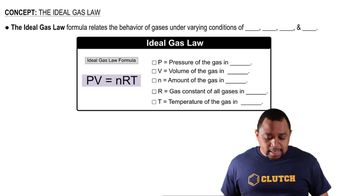
The Ideal Gas Law is a fundamental equation in chemistry that relates the pressure, volume, temperature, and number of moles of a gas. It is expressed as PV = nRT, where P is pressure, V is volume, n is the number of moles, R is the ideal gas constant, and T is temperature in Kelvin. This law allows us to calculate the properties of gases under various conditions.
Video consigliato:
Percorso guidato
01:15
Ideal Gas Law Formula

Molar Mass

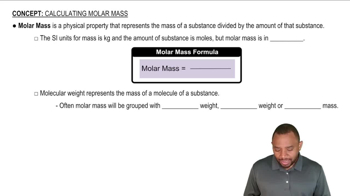
Molar mass is the mass of one mole of a substance, typically expressed in grams per mole (g/mol). For helium, the molar mass is approximately 4.00 g/mol. Understanding molar mass is essential for converting between the mass of a gas and the number of moles, which is necessary for applying the Ideal Gas Law.
Video consigliato:
Percorso guidato
02:11
Molar Mass Concept

Gas Density

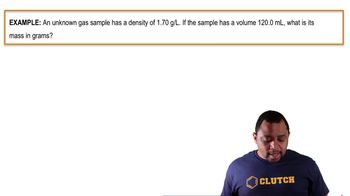
Gas density is defined as the mass of a gas per unit volume, usually expressed in grams per liter (g/L). It can be calculated using the formula density = mass/volume. Knowing the density of a gas allows for the determination of its mass when the volume is known, which is crucial for solving problems involving gas quantities.
Video consigliato:
Percorso guidato
01:21
Gas Density Example