
Naphthalene (C10H8) is the main ingredient in traditional mothballs. Its normal melting point is 81 °C, its normal boiling point is 218 °C, and its triple point is 80 °C at 1000 Pa. Using the data, construct a phase diagram for naphthalene, labeling all the regions of your diagram.
Ch.11 - Liquids and Intermolecular Forces
Brown14th EditionChemistry: The Central ScienceISBN: 9780134414232Non è quello che usi tu?Cambia libro di testo
Capitolo 11, Problema 89
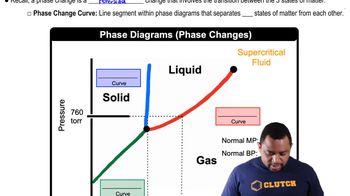
A particular liquid crystalline substance has the phase diagram shown in the figure. By analogy with the phase diagram for a nonliquid crystalline substance, identify the phase present in each area.
Guida verificata passo dopo passo1
Identify the axes of the phase diagram. Typically, the x-axis represents temperature and the y-axis represents pressure.
Locate the different regions or areas on the phase diagram. Each region corresponds to a different phase of the substance.
Identify the phase boundaries, which are the lines separating different regions. These lines indicate the conditions under which two phases coexist in equilibrium.
Determine the phases present in each region by comparing the phase diagram to a typical phase diagram for a nonliquid crystalline substance. Common phases include solid, liquid, and gas, but liquid crystalline substances may have additional phases such as nematic, smectic, or cholesteric.
Label each region with the appropriate phase name based on the characteristics of liquid crystalline substances and the analogy to nonliquid crystalline phase diagrams.

Risposta video verificata per un problema simile:
Questa soluzione video è stata consigliata dai nostri tutor come utile per risolvere questo problema.
Durata del video:
58sConcetti chiave
Ecco i concetti essenziali che devi comprendere per rispondere correttamente alla domanda.
Phase Diagrams
Phase diagrams are graphical representations that show the phases of a substance as a function of temperature and pressure. They illustrate the conditions under which distinct phases, such as solid, liquid, and gas, exist and transition into one another. Understanding phase diagrams is crucial for predicting the state of a substance under varying environmental conditions.
Video consigliato:
Percorso guidato
Phase Changes in Diagrams
Liquid Crystals
Liquid crystals are materials that exhibit properties between those of conventional liquids and solid crystals. They can flow like a liquid but have some degree of order, typically in their molecular arrangement. This unique behavior allows them to respond to electric fields and temperature changes, making them important in applications like displays and sensors.
Video consigliato:
Percorso guidato
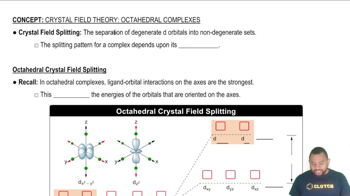
The crystal field splitting pattern for octahedral complexes has the d orbitals on or along the axes as having the higher energy.
Phase Transitions
Phase transitions refer to the changes in the state of matter that occur when a substance absorbs or releases energy, typically in the form of heat. Common transitions include melting, freezing, boiling, and condensation. In the context of liquid crystals, understanding these transitions is essential for identifying the different phases represented in a phase diagram.
Video consigliato:
Percorso guidato
Phase Changes in Diagrams
Pratica correlata
Domanda del libro di testo
2401
views
Domanda del libro di testo
The vapor pressure of ethanol (C2H5OH) at 19 °C is 40.0 torr. A 1.00-g sample of ethanol is placed in a 2.00 L container at 19 °C. If the container is closed and the ethanol is allowed to reach equilibrium with its vapor, how many grams of liquid ethanol remain?
1363
views
Domanda del libro di testo
The following data present the temperatures at which certain vapor pressures are achieved for dichloromethane (CH2Cl2) and methyl iodide (CH3I): (c) The order of volatility of these two substances changes as the temperature is increased. What quantity must be different for the two substances for this phenom- enon to occur?
378
views
Domanda del libro di testo
In Table 11.3, we saw that the viscosity of a series of hydrocarbons increased with molecular weight, doubling from the six-carbon molecule to the ten-carbon molecule.
(a) The eight-carbon hydrocarbon, octane, has an isomer, isooctane. Would you predict that isooctane would have a larger or smaller viscosity than octane? Why?
530
views
