
Ch.11 - Liquids and Intermolecular Forces
Brown - Chemistry: The Central Science 14th Edition
Brown14th EditionChemistry: The Central ScienceISBN: 9780134414232Non è quello che usi tu?Cambia libro di testo
Capitolo 11, Problema 93

The vapor pressure of ethanol (C2H5OH) at 19 °C is 40.0 torr. A 1.00-g sample of ethanol is placed in a 2.00 L container at 19 °C. If the container is closed and the ethanol is allowed to reach equilibrium with its vapor, how many grams of liquid ethanol remain?

Guida verificata passo dopo passo
1
First, we need to convert the vapor pressure of ethanol from torr to atmospheres because the ideal gas law uses pressure in atmospheres. We can do this using the conversion factor 1 atm = 760 torr.
Next, we use the ideal gas law (PV=nRT) to calculate the number of moles of ethanol in the vapor phase. In this case, P is the pressure in atmospheres, V is the volume in liters, n is the number of moles, R is the ideal gas constant (0.0821 L·atm/K·mol), and T is the temperature in Kelvin.
Once we have the number of moles of ethanol in the vapor phase, we can convert this to grams using the molar mass of ethanol (46.07 g/mol). This will give us the mass of ethanol that has evaporated.
We then subtract the mass of evaporated ethanol from the initial mass of ethanol to find the mass of liquid ethanol that remains.
Remember that the ideal gas law assumes ideal behavior, so this calculation will be an approximation. Real gases do not always behave ideally, especially at high pressures and low temperatures.

Risposta video verificata per un problema simile:

Questa soluzione video è stata consigliata dai nostri tutor come utile per risolvere questo problema.
Durata del video:
5m

Concetti chiave

Ecco i concetti essenziali che devi comprendere per rispondere correttamente alla domanda.

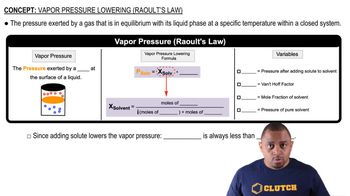
Vapor Pressure

Vapor pressure is the pressure exerted by a vapor in equilibrium with its liquid or solid phase at a given temperature. It indicates the tendency of a substance to evaporate; higher vapor pressure means a greater tendency to vaporize. For ethanol at 19 °C, the vapor pressure is 40.0 torr, which is crucial for determining how much liquid will remain when equilibrium is reached.
Video consigliato:
Percorso guidato
02:40
Raoult's Law and Vapor Pressure

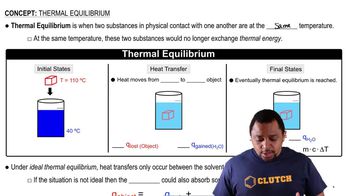
Equilibrium

In chemistry, equilibrium refers to the state where the rates of the forward and reverse reactions are equal, resulting in constant concentrations of reactants and products. In this scenario, the equilibrium between liquid ethanol and its vapor will dictate how much ethanol remains in the liquid state once the system stabilizes in the closed container.
Video consigliato:
Percorso guidato
02:35
Thermal Equilibrium

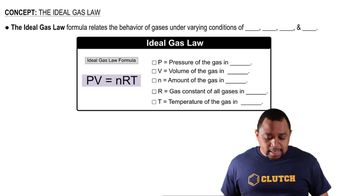
Ideal Gas Law

The Ideal Gas Law (PV = nRT) relates the pressure, volume, temperature, and number of moles of a gas. In this problem, it can be used to calculate the number of moles of ethanol vapor present at equilibrium, which helps determine how much liquid ethanol remains after some has evaporated into the vapor phase.
Video consigliato:
Percorso guidato
01:15
Ideal Gas Law Formula