Ch.11 - Liquids and Intermolecular Forces
Brown - Chemistry: The Central Science 14th Edition
Brown14th EditionChemistry: The Central ScienceISBN: 9780134414232Non è quello che usi tu?Cambia libro di testo
Capitolo 11, Problema 53

A large container of water and a small one are at the same temperature. What can be said about the relative vapor pressures of the water in the two containers?

Guida verificata passo dopo passo
1
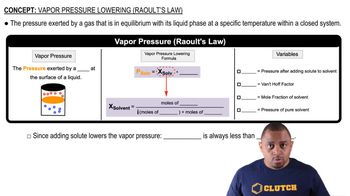
Understand that vapor pressure is the pressure exerted by a vapor in equilibrium with its liquid phase at a given temperature.
Recognize that vapor pressure is a property that depends on the temperature and the nature of the liquid, not the amount of liquid present.
Since both containers are at the same temperature and contain the same liquid (water), the vapor pressure of water in both containers will be the same.
Consider that the size of the container does not affect the vapor pressure, as vapor pressure is an intensive property, meaning it does not depend on the quantity of the substance.
Conclude that the relative vapor pressures of the water in the two containers are equal because they are determined solely by the temperature and the identity of the liquid.

Concetti chiave

Ecco i concetti essenziali che devi comprendere per rispondere correttamente alla domanda.

Vapor Pressure

Vapor pressure is the pressure exerted by a vapor in equilibrium with its liquid or solid phase at a given temperature. It reflects the tendency of particles to escape from the liquid into the vapor phase. Higher temperatures generally increase vapor pressure, as more molecules have sufficient energy to overcome intermolecular forces.
Video consigliato:
Percorso guidato
02:40
Raoult's Law and Vapor Pressure

Surface Area and Vapor Pressure

The surface area of a liquid affects its rate of evaporation but does not directly influence its vapor pressure at equilibrium. In a larger container, more molecules are available to escape into the vapor phase, but the vapor pressure remains determined by the temperature and the nature of the liquid, not the container size.
Video consigliato:
Percorso guidato
02:40
Raoult's Law and Vapor Pressure

Equilibrium in Closed Systems

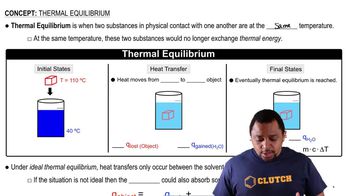
In a closed system, a dynamic equilibrium is established between the liquid and vapor phases, where the rate of evaporation equals the rate of condensation. At this point, the vapor pressure is constant and depends solely on the temperature and the identity of the liquid, not the volume of the liquid present.
Video consigliato:
Percorso guidato
02:35
Thermal Equilibrium
Pratica correlata
Domanda del libro di testo

(a) Two pans of water are on different burners of a stove. One pan of water is boiling vigorously, while the other is boiling gently. What can be said about the temperature of the water in the two pans?

663
views

Domanda del libro di testo

You are high up in the mountains and boil water to make some tea. However, when you drink your tea, it is not as hot as it should be. You try again and again, but the water is just not hot enough to make a hot cup of tea. Which is the best explanation for this result? (a) High in the mountains, it is probably very dry, and so the water is rapidly evaporating from your cup and cooling it. (b) High in the mountains, it is probably very windy, and so the water is rapidly evaporating from your cup and cooling it. (c) High in the mountains, the air pressure is significantly less than 1 atm, so the boiling point of water is much lower than at sea level. (d) High in the mountains, the air pressure is significantly less than 1 atm, so the boiling point of water is much higher than at sea level.

1034
views
Domanda del libro di testo

(a) Place the following substances in order of increasing volatility: CH4, CBr4, CH2Cl2, CH3Cl, CHBr3, and CH2Br2. (b) How do the boiling points vary through this series? (c) Explain your answer to part (b) in terms of intermolecular forces.

3117
views
1
rank
Domanda del libro di testo

Using the vapor-pressure curves in Figure 11.25, (d) estimate the external pressure at which diethyl ether will boil at 40 °C.

1151
views