
Ch.11 - Liquids and Intermolecular Forces
Brown - Chemistry: The Central Science 14th Edition
Brown14th EditionChemistry: The Central ScienceISBN: 9780134414232Non è quello che usi tu?Cambia libro di testo
Capitolo 11, Problema 58

(b) Could you measure the triple point of water by measuring the temperature in a vessel in which water vapor, liquid water, and ice are in equilibrium under 1 atm of air? Explain.

Guida verificata passo dopo passo
1
Understand the concept of the triple point: The triple point of a substance is the unique set of conditions at which all three phases (solid, liquid, and gas) coexist in equilibrium.
Recognize the specific conditions for the triple point of water: The triple point of water occurs at a temperature of 0.01°C and a pressure of 611.657 pascals (0.00604 atm), which is much lower than 1 atm.
Consider the effect of atmospheric pressure: At 1 atm, the conditions do not match the specific pressure required for the triple point of water, as the atmospheric pressure is significantly higher than the pressure at the triple point.
Analyze the phase equilibrium: Under 1 atm, water can exist in equilibrium between liquid and vapor (boiling point) or between solid and liquid (melting point), but not all three phases simultaneously as required for the triple point.
Conclude that measuring the triple point under 1 atm is not possible: Since the pressure is not at the specific value required for the triple point, you cannot measure the triple point of water under 1 atm of air.

Risposta video verificata per un problema simile:

Questa soluzione video è stata consigliata dai nostri tutor come utile per risolvere questo problema.
Durata del video:
1m

Concetti chiave

Ecco i concetti essenziali che devi comprendere per rispondere correttamente alla domanda.

Triple Point

The triple point of a substance is the unique set of conditions at which all three phases—solid, liquid, and gas—coexist in thermodynamic equilibrium. For water, this occurs at a specific temperature and pressure, which is precisely 0.01°C and 611.657 pascals. Understanding this concept is crucial for recognizing how temperature and pressure influence phase changes.
Video consigliato:
Percorso guidato
03:05
Boiling Point Elevation

Phase Equilibrium

Phase equilibrium refers to the state in which the different phases of a substance (solid, liquid, gas) exist simultaneously and their properties remain constant over time. In the context of the triple point, it means that the rates of phase transitions (melting, freezing, evaporation, condensation) are equal, allowing for stable coexistence of ice, water, and vapor.
Video consigliato:
Percorso guidato
03:22
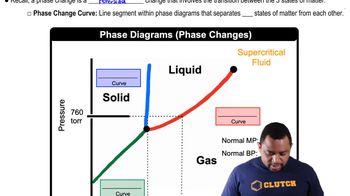
Phase Changes in Diagrams

Measurement Conditions

Accurate measurement of the triple point requires specific conditions, including a controlled environment where pressure and temperature are precisely maintained. In the case of water, achieving the triple point under 1 atm of air is not possible, as the pressure must be lower than atmospheric pressure to allow for the coexistence of all three phases. This highlights the importance of understanding how external conditions affect phase behavior.
Video consigliato:
Percorso guidato
02:52
Units of Radiation Measurement