Ch.11 - Liquids and Intermolecular Forces
Brown - Chemistry: The Central Science 14th Edition
Brown14th EditionChemistry: The Central ScienceISBN: 9780134414232Non è quello che usi tu?Cambia libro di testo
Capitolo 11, Problema 10c

(c) What happens to a gas if you put it under extremely high pressure?

Guida verificata passo dopo passo
1
Identify the properties of gases under normal conditions, where they have random motion and occupy the entire volume of their container.
Understand that applying pressure to a gas reduces its volume, as described by Boyle's Law, which states that the pressure of a gas is inversely proportional to its volume when temperature is constant (P \(\propto\) 1/V).
Consider the kinetic molecular theory, which explains that increasing pressure forces gas molecules closer together, which can increase the frequency of collisions between the molecules.
Recognize that at extremely high pressures, the gas molecules are forced into close proximity, potentially leading to a phase change from gas to liquid if the temperature is below the critical temperature of the substance.
Explore the implications of such high pressure on real-life systems, such as in industrial applications where gases are compressed and stored as liquids for better efficiency and safety.

Risposta video verificata per un problema simile:

Questa soluzione video è stata consigliata dai nostri tutor come utile per risolvere questo problema.
Durata del video:
1m

Concetti chiave

Ecco i concetti essenziali che devi comprendere per rispondere correttamente alla domanda.

Gas Laws

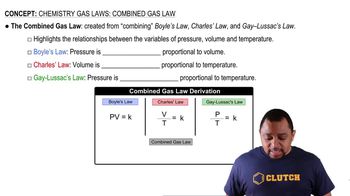
Gas laws describe the behavior of gases under various conditions of temperature, pressure, and volume. The most relevant laws include Boyle's Law, which states that pressure and volume are inversely related at constant temperature, and Charles's Law, which relates volume and temperature. Understanding these laws helps predict how a gas will respond to changes in pressure.
Video consigliato:
Percorso guidato
01:43
Combined Gas Law

Compressibility

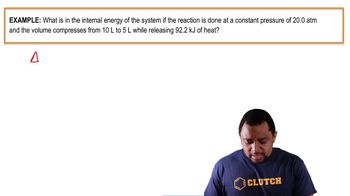
Compressibility refers to the ability of a substance to decrease in volume under pressure. Gases are highly compressible compared to liquids and solids, meaning that applying high pressure can significantly reduce their volume. This property is crucial in applications like gas storage and transport, where gases are often compressed to save space.
Video consigliato:
Percorso guidato
02:29
Internal Energy Example 1

Phase Changes

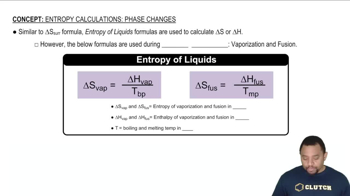
Phase changes occur when a substance transitions between solid, liquid, and gas states due to changes in temperature or pressure. Under extremely high pressure, gases can undergo phase changes, potentially becoming liquids or even solids, depending on the temperature and the specific gas involved. This concept is essential for understanding the behavior of gases in extreme conditions.
Video consigliato:
Percorso guidato
01:46
Entropy in Phase Changes