
Ch.11 - Liquids and Intermolecular Forces
Brown - Chemistry: The Central Science 14th Edition
Brown14th EditionChemistry: The Central ScienceISBN: 9780134414232Non è quello che usi tu?Cambia libro di testo
Capitolo 11, Problema 12a

At room temperature, Si is a solid, CCl4 is a liquid, and Ar is a gas. List these substances in order of (a) increasing intermolecular energy of attraction

Guida verificata passo dopo passo
1
1. The intermolecular energy of attraction is determined by the type of bonding and the strength of the forces between the particles in a substance. The stronger the forces, the higher the intermolecular energy of attraction.
2. Silicon (Si) is a solid at room temperature because it forms a covalent network structure, where each atom is bonded to its neighbors by strong covalent bonds. This results in a very high intermolecular energy of attraction.
3. Carbon tetrachloride (CCl4) is a liquid at room temperature. It is a molecular compound with polar covalent bonds, but the molecule as a whole is nonpolar due to its symmetrical tetrahedral shape. Therefore, the intermolecular forces are weaker dispersion forces, resulting in a lower intermolecular energy of attraction than Si.
4. Argon (Ar) is a gas at room temperature. It is a noble gas and exists as individual atoms. The only intermolecular forces present are weak dispersion forces, which result in a very low intermolecular energy of attraction.
5. Therefore, the order of increasing intermolecular energy of attraction is Ar < CCl4 < Si.

Risposta video verificata per un problema simile:

Questa soluzione video è stata consigliata dai nostri tutor come utile per risolvere questo problema.
Durata del video:
1m

Concetti chiave

Ecco i concetti essenziali che devi comprendere per rispondere correttamente alla domanda.

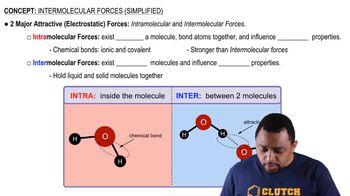
Intermolecular Forces

Intermolecular forces are the forces of attraction or repulsion between neighboring particles (atoms, molecules, or ions). These forces determine the physical properties of substances, such as boiling and melting points. Stronger intermolecular forces result in higher energy requirements to change states, while weaker forces allow for easier transitions between solid, liquid, and gas phases.
Video consigliato:
Percorso guidato
01:59
Intermolecular vs Intramolecular Forces

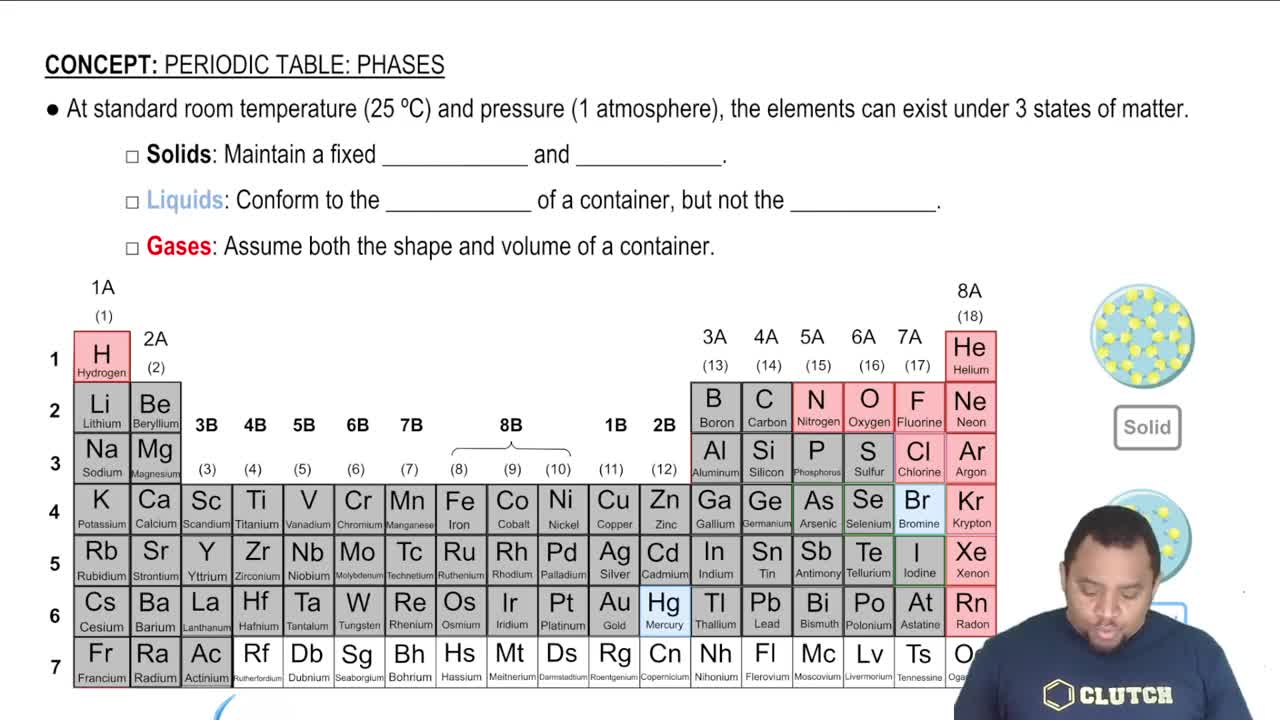
States of Matter

The states of matter—solid, liquid, and gas—are defined by the arrangement and energy of particles. In solids, particles are closely packed and vibrate in fixed positions, leading to strong intermolecular forces. In liquids, particles are still close but can move past one another, resulting in moderate intermolecular forces. Gases have particles that are far apart and move freely, indicating weak intermolecular forces.
Video consigliato:
Percorso guidato
03:25
Element States of Matter

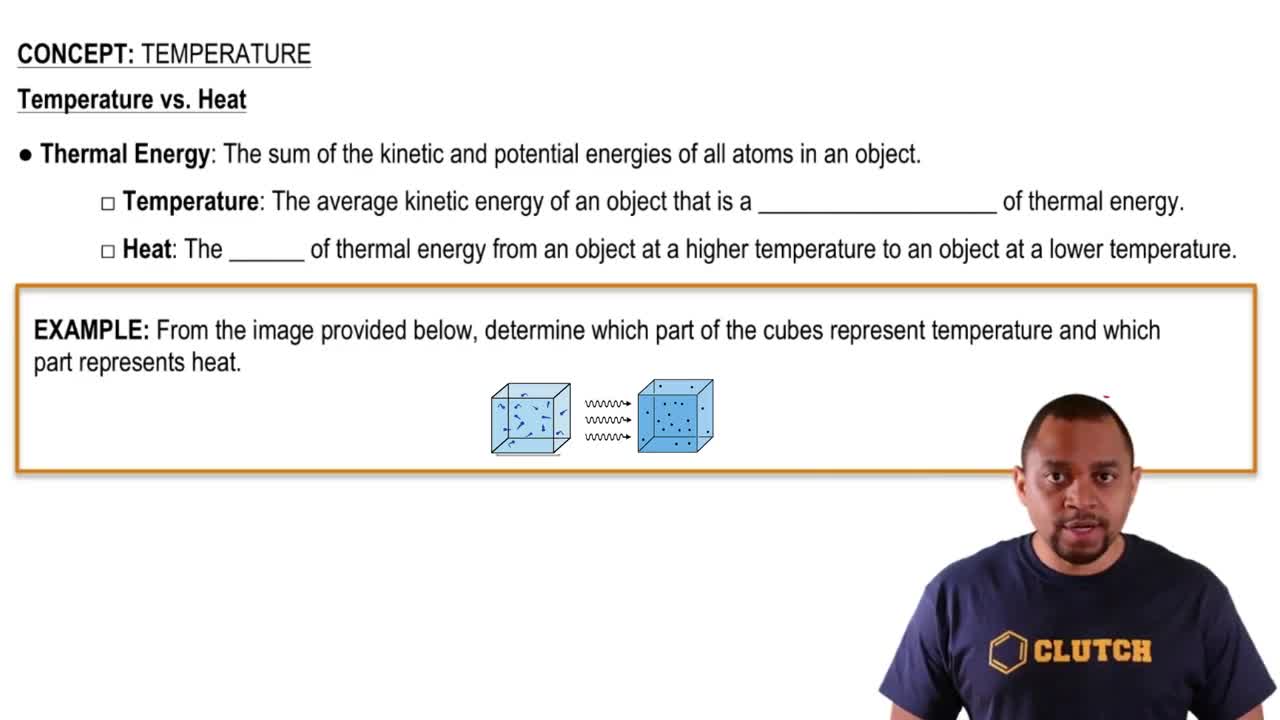
Temperature and Energy

Temperature is a measure of the average kinetic energy of particles in a substance. At room temperature, the kinetic energy of particles in gases is higher than in liquids and solids, which affects their intermolecular interactions. As temperature increases, the energy can overcome intermolecular forces, leading to phase changes, such as melting or boiling.
Video consigliato:
Percorso guidato
03:48
Temperature vs Heat