(c) Which type of intermolecular attractive force operates only between the hydrogen atom of a polar bond and a nearby small electronegative atom?
Ch.11 - Liquids and Intermolecular Forces
Brown14th EditionChemistry: The Central ScienceISBN: 9780134414232Non è quello che usi tu?Cambia libro di testo
Capitolo 11, Problema 17
Describe the intermolecular forces that must be overcome to convert these substances from a liquid to a gas: (a) SO2, (b) CH3COOH, (c) H2S.
Guida verificata passo dopo passo1
Identify the molecular structure of CH3COOH (acetic acid). It contains a carboxyl group (COOH) and a methyl group (CH3).
Recognize the types of intermolecular forces present in CH3COOH. These include hydrogen bonding, dipole-dipole interactions, and London dispersion forces.
Understand that hydrogen bonding is the strongest intermolecular force in CH3COOH due to the presence of the hydroxyl group (OH) in the carboxyl group, which can form hydrogen bonds with the oxygen atom of another molecule.
Consider the dipole-dipole interactions that occur because of the polar nature of the C=O and O-H bonds in the carboxyl group, contributing to the overall polarity of the molecule.
Acknowledge that to convert CH3COOH from a liquid to a gas, energy must be supplied to overcome these intermolecular forces, with the most energy required to break the hydrogen bonds.

Risposta video verificata per un problema simile:
Questa soluzione video è stata consigliata dai nostri tutor come utile per risolvere questo problema.
Durata del video:
1mConcetti chiave
Ecco i concetti essenziali che devi comprendere per rispondere correttamente alla domanda.
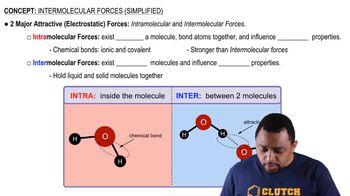
Intermolecular Forces
Intermolecular forces are the attractive forces between molecules that influence their physical properties, such as boiling and melting points. These forces include hydrogen bonding, dipole-dipole interactions, and London dispersion forces. Understanding these interactions is crucial for predicting how much energy is required to change a substance from one state to another, such as from liquid to gas.
Video consigliato:
Percorso guidato
Intermolecular vs Intramolecular Forces
Hydrogen Bonding
Hydrogen bonding is a specific type of strong dipole-dipole interaction that occurs when hydrogen is bonded to highly electronegative atoms like oxygen, nitrogen, or fluorine. In the case of acetic acid (CH3COOH), hydrogen bonds form between the hydrogen atom of one molecule and the oxygen atom of another. These bonds must be overcome for the substance to vaporize, making them significant in determining the boiling point.
Video consigliato:
Percorso guidato
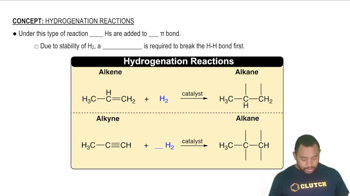
Hydrogenation Reactions
Boiling Point
The boiling point of a substance is the temperature at which its vapor pressure equals the external pressure, allowing it to transition from liquid to gas. The boiling point is influenced by the strength of intermolecular forces; stronger forces result in higher boiling points. For acetic acid, the presence of hydrogen bonding leads to a relatively high boiling point compared to other similar-sized molecules without such interactions.
Video consigliato:
Percorso guidato
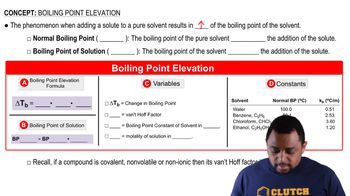
Boiling Point Elevation
Pratica correlata
Domanda del libro di testo
422
views
Domanda del libro di testo
Which type of intermolecular force accounts for each of these differences? (b) Xe is a liquid at atmospheric pressure and 120 K, whereas Ar is a gas under the same conditions. (c) Kr, atomic weight 84 amu, boils at 120.9 K, whereas Cl2, molecular weight about 71 amu, boils at 238 K.
781
views
Domanda del libro di testo
Which type of intermolecular force accounts for each of these differences? (a) CH3OH boils at 65 °C; CH3SH boils at 6 °C. (d) Acetone boils at 56 °C, whereas 2-methylpropane boils at -12 °C.
440
views
Domanda del libro di testo
(a) List the following molecules in order of increasing polar- izability: GeCl4, CH4, SiCl4, SiH4, and GeBr4. (b) Predict the order of boiling points of the substances in part (a).
1317
views
Domanda del libro di testo
(b) Which of these kinds of interactions are broken when a liquid is converted to a gas?
403
views