
Ch.11 - Liquids and Intermolecular Forces
Brown - Chemistry: The Central Science 14th Edition
Brown14th EditionChemistry: The Central ScienceISBN: 9780134414232Non è quello che usi tu?Cambia libro di testo
Capitolo 11, Problema 94

Liquid butane (C4H10) is stored in cylinders to be used as a fuel. The normal boiling point of butane is listed as -0.5 °C. (b) Suppose the valve to the tank is opened and a few liters of butane are allowed to escape rapidly. What do you expect would happen to the temperature of the remaining liquid butane in the tank? Explain.

Guida verificata passo dopo passo
1
Identify the process occurring when butane escapes: This is an example of adiabatic expansion, where the butane expands rapidly and does work on the surroundings.
Understand the energy changes: In adiabatic processes, there is no heat exchange with the surroundings, so the energy for the work done comes from the internal energy of the butane.
Relate internal energy to temperature: The internal energy of a substance is related to its temperature. As the internal energy decreases due to work being done, the temperature of the remaining liquid butane will also decrease.
Consider the effect of temperature change: As the temperature decreases, the remaining liquid butane will become cooler, potentially dropping below its normal boiling point.
Conclude the expected outcome: The rapid escape of butane causes a decrease in temperature of the remaining liquid, which may lead to further condensation of butane vapor back into liquid form.

Risposta video verificata per un problema simile:

Questa soluzione video è stata consigliata dai nostri tutor come utile per risolvere questo problema.
Durata del video:
2m

Concetti chiave

Ecco i concetti essenziali che devi comprendere per rispondere correttamente alla domanda.

Boiling Point and Vaporization

The boiling point of a substance is the temperature at which its vapor pressure equals the external pressure, allowing it to transition from liquid to gas. For butane, the normal boiling point is -0.5 °C, meaning it will vaporize at this temperature under standard atmospheric pressure. When butane escapes from the tank, it vaporizes, absorbing heat from the remaining liquid, which can lower the temperature of the liquid butane.
Video consigliato:
Percorso guidato
03:05
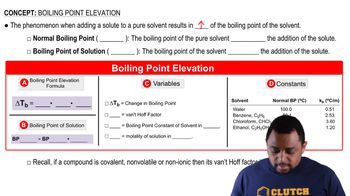
Boiling Point Elevation

Heat of Vaporization

The heat of vaporization is the amount of energy required to convert a unit mass of a liquid into vapor without a change in temperature. For butane, this process requires significant energy, which is drawn from the remaining liquid butane in the tank. As the escaping gas absorbs heat, the temperature of the liquid butane decreases, leading to a cooling effect.
Video consigliato:

Thermodynamics and Energy Transfer

Thermodynamics is the study of energy transfer and its effects on matter. When butane vaporizes, it undergoes an endothermic process, meaning it absorbs heat from its surroundings. This energy transfer results in a decrease in the temperature of the remaining liquid butane, illustrating the principles of energy conservation and the relationship between phase changes and temperature.
Video consigliato:
Percorso guidato
01:18
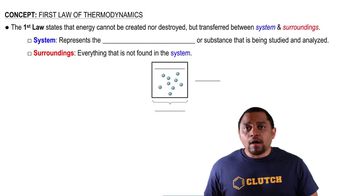
First Law of Thermodynamics