
Ch.11 - Liquids and Intermolecular Forces
Brown - Chemistry: The Central Science 14th Edition
Brown14th EditionChemistry: The Central ScienceISBN: 9780134414232Non è quello che usi tu?Cambia libro di testo
Capitolo 11, Problema 76a

Two isomers of the planar compound 1,2-dichloroethylene are shown here.
(a) Which of the two isomers will have the stronger dipole– dipole forces?

Guida verificata passo dopo passo
1
Identify the structures of the two isomers of 1,2-dichloroethylene, which are typically cis-1,2-dichloroethylene and trans-1,2-dichloroethylene.
Understand the concept of dipole moments: A dipole moment arises from the difference in electronegativity between two chemically bonded atoms. The greater the difference in electronegativity, the stronger the dipole moment.
Analyze the molecular geometry of each isomer. In the cis isomer, the chlorine atoms are on the same side of the double bond, which results in a net dipole moment pointing from the center of the molecule towards the chlorine atoms. In the trans isomer, the chlorine atoms are on opposite sides, which results in the cancellation of their dipole moments.
Compare the net dipole moments: Since the dipole moments in the trans isomer cancel each other out, it has a zero net dipole moment. The cis isomer, however, has a non-zero net dipole moment because the dipoles do not cancel out.
Conclude which isomer has stronger dipole-dipole forces: The cis-1,2-dichloroethylene, with a non-zero dipole moment, will exhibit stronger dipole-dipole interactions compared to the trans isomer.

Risposta video verificata per un problema simile:

Questa soluzione video è stata consigliata dai nostri tutor come utile per risolvere questo problema.
Durata del video:
2m

Concetti chiave

Ecco i concetti essenziali che devi comprendere per rispondere correttamente alla domanda.

Isomerism

Isomerism refers to the phenomenon where two or more compounds have the same molecular formula but different structural arrangements or spatial orientations. In the case of 1,2-dichloroethylene, the two isomers can be classified as cis and trans, which differ in the positioning of the chlorine atoms around the double bond. This difference in structure can significantly affect the physical and chemical properties of the compounds, including their polarity.
Video consigliato:
Percorso guidato
2:14
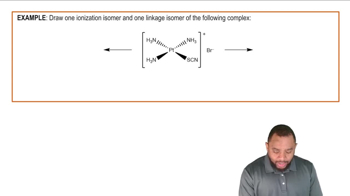
Isomerism in Coordination Complexes Example

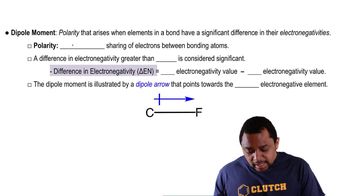
Dipole-Dipole Interactions

Dipole-dipole interactions are a type of intermolecular force that occurs between polar molecules. These forces arise due to the attraction between the positive end of one polar molecule and the negative end of another. The strength of dipole-dipole interactions is influenced by the polarity of the molecules; more polar molecules exhibit stronger dipole-dipole forces, which can affect boiling points and solubility.
Video consigliato:

Polarity

Polarity in chemistry refers to the distribution of electrical charge over the atoms in a molecule. A molecule is considered polar if it has a significant difference in electronegativity between its atoms, leading to an uneven distribution of charge. In the context of 1,2-dichloroethylene, the cis isomer is generally more polar than the trans isomer due to the arrangement of the chlorine atoms, which affects the overall dipole moment and, consequently, the strength of dipole-dipole interactions.
Video consigliato:
Percorso guidato
02:38
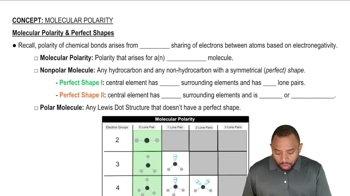
Molecular Polarity