
Suppose you have two colorless molecular liquids, one boiling at - 84 °C, the other at 34 °C, and both at atmospheric 6 pressure. Which of the following statements is correct? For each statement that is not correct, modify the statement so that it is correct. (d) The two liquids have identical vapor pressures at their normal boiling points.
Ch.11 - Liquids and Intermolecular Forces
Brown14th EditionChemistry: The Central ScienceISBN: 9780134414232Non è quello che usi tu?Cambia libro di testo
Capitolo 11, Problema 75e
Suppose you have two colorless molecular liquids, one boiling at - 84 °C, the other at 34 °C, and both at atmospheric 6 pressure. Which of the following statements is correct? For each statement that is not correct, modify the statement so that it is correct. (e) At - 84 °C both liquids have vapor pressures of 760 mm Hg.
Guida verificata passo dopo passo1
Identify the boiling point of each liquid: Liquid A boils at -84 °C and Liquid B boils at 34 °C.
Understand that the boiling point of a liquid is the temperature at which its vapor pressure equals the external pressure, typically 760 mm Hg at atmospheric pressure.
Since Liquid A boils at -84 °C, its vapor pressure is 760 mm Hg at this temperature.
Since Liquid B boils at 34 °C, its vapor pressure is 760 mm Hg at this temperature.
Therefore, at -84 °C, only Liquid A has a vapor pressure of 760 mm Hg, not both liquids.

Risposta video verificata per un problema simile:
Questa soluzione video è stata consigliata dai nostri tutor come utile per risolvere questo problema.
Durata del video:
59sConcetti chiave
Ecco i concetti essenziali che devi comprendere per rispondere correttamente alla domanda.
Boiling Point and Vapor Pressure
The boiling point of a liquid is the temperature at which its vapor pressure equals the atmospheric pressure. At this point, the liquid transitions to a gas. For the liquid boiling at -84 °C, it will have a vapor pressure of 760 mm Hg at that temperature, but the other liquid, boiling at 34 °C, will not necessarily have the same vapor pressure at -84 °C.
Video consigliato:
Percorso guidato
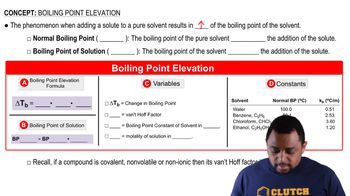
Boiling Point Elevation
Vapor Pressure and Temperature Relationship
Vapor pressure is the pressure exerted by a vapor in equilibrium with its liquid at a given temperature. As temperature increases, the vapor pressure of a liquid also increases. Therefore, at -84 °C, the vapor pressures of both liquids will be lower than 760 mm Hg, making the statement about both having the same vapor pressure at that temperature incorrect.
Video consigliato:
Percorso guidato
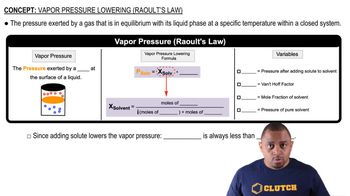
Raoult's Law and Vapor Pressure
Atmospheric Pressure
Atmospheric pressure is the pressure exerted by the weight of the atmosphere at a given location, typically measured at sea level as 760 mm Hg. This pressure is crucial for understanding boiling points and vapor pressures, as liquids will boil when their vapor pressure matches this atmospheric pressure. The statement in question fails to consider that vapor pressures vary with temperature and are not constant across different liquids.
Video consigliato:
Percorso guidato
Total Pressure Example
Pratica correlata
Domanda del libro di testo
668
views
Domanda del libro di testo
The table below lists the density of O2 at various temperatures and at 1 atm. The normal melting point of O2 is 54 K.
(b) Over what temperature range is O2 a liquid?
519
views
Domanda del libro di testo
Two isomers of the planar compound 1,2-dichloroethylene are shown here.
(a) Which of the two isomers will have the stronger dipole– dipole forces?
585
views
Domanda del libro di testo
The table below shows the normal boiling points of benzene and benzene derivatives.
(a) How many of these compounds exhibit dispersion interactions?
347
views
Domanda del libro di testo
The table below shows the normal boiling points of benzene and benzene derivatives. (e) Why is the boiling point of phenol the highest of all?
775
views
1
rank
