
Ethylene glycol (HOCH2CH2OH), the major substance in antifreeze, has a normal boiling point of 198 °C. By comparison, ethyl alcohol (CH3CH2OH) boils at 78 °C at atmospheric pressure. Ethylene glycol dimethyl ether (CH3OCH2CH2OCH3) has a normal boiling point of 83 °C, and ethyl methyl ether (CH3CH2OCH3) has a nomral boiling point of 11 °C. (a) Explain why replacement of a hydrogen on the oxygen by a CH3 group generally results in a lower boiling point.
Ch.11 - Liquids and Intermolecular Forces
Brown14th EditionChemistry: The Central ScienceISBN: 9780134414232Non è quello che usi tu?Cambia libro di testo
Capitolo 11, Problema 22
Which member in each pair has the stronger intermolecular dispersion forces? (a) Br2 or O2 (b) CH3CH2CH2CH2SH or CH3CH2CH2CH2CH2SH (c) CH3CH2CH2Cl or (CH3)2CHCl
Guida verificata passo dopo passo1
Identify the type of intermolecular forces present in both molecules. Both CH3CH2CH2Cl and (CH3)2CHCl primarily exhibit dispersion forces (London dispersion forces), which are influenced by the molar mass and shape of the molecule.
Compare the molar masses of the two molecules. Generally, a higher molar mass leads to stronger dispersion forces because there are more electrons that can contribute to temporary dipoles.
Analyze the molecular shapes and sizes. Molecules with a larger surface area in contact can have stronger dispersion forces because there are more opportunities for temporary dipoles to interact.
Consider the branching in the molecules. More branching typically reduces the surface area in contact and can lead to weaker dispersion forces compared to a less branched isomer.
Based on the molar mass, molecular shape, and degree of branching, determine which molecule would have the stronger dispersion forces.

Risposta video verificata per un problema simile:
Questa soluzione video è stata consigliata dai nostri tutor come utile per risolvere questo problema.
Durata del video:
1mConcetti chiave
Ecco i concetti essenziali che devi comprendere per rispondere correttamente alla domanda.
Intermolecular Forces
Intermolecular forces are the forces of attraction or repulsion between molecules. They play a crucial role in determining the physical properties of substances, such as boiling and melting points. The main types of intermolecular forces include hydrogen bonding, dipole-dipole interactions, and dispersion forces, with dispersion forces being the weakest and arising from temporary dipoles in molecules.
Video consigliato:
Percorso guidato
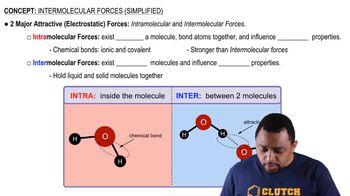
Intermolecular vs Intramolecular Forces
Dispersion Forces
Dispersion forces, also known as London dispersion forces, are a type of van der Waals force that occur due to the momentary distribution of electron density in atoms or nonpolar molecules. These forces increase with the size and polarizability of the molecules involved. Larger molecules with more electrons can create stronger temporary dipoles, leading to stronger dispersion forces.
Video consigliato:
Percorso guidato
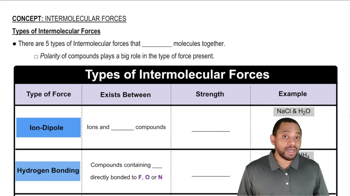
Types of Intermolecular Forces
Molecular Structure and Polarity
The molecular structure and polarity of a compound significantly influence its intermolecular forces. In the given compounds, the branching and presence of chlorine affect how closely molecules can pack together and the strength of their dispersion forces. Generally, less branched molecules can have stronger dispersion forces due to a larger surface area for interactions compared to more branched counterparts.
Video consigliato:
Percorso guidato
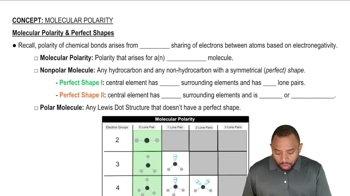
Molecular Polarity
Pratica correlata
Domanda del libro di testo
2179
views
Domanda del libro di testo
Which member in each pair has the greater dispersion forces? (b) CO2 or CO, (c) SiH4 or GeH4.
755
views
Domanda del libro di testo
Which member in each pair has the greater dispersion forces? (a) H2O or H2S,
685
views
Domanda del libro di testo
True or false: (e) The larger the atom, the more polarizable it is.
802
views
Domanda del libro di testo
(a) What atoms must a molecule contain to participate in hydrogen bonding with other molecules of the same kind? (b) Which of the following molecules can form hydrogen bonds with other molecules of the same kind: CH3F, CH3NH2, CH3OH, CH3Br?
2322
views
1
rank
