Ch.12 - Solids and Modern Materials
Brown - Chemistry: The Central Science 14th Edition
Brown14th EditionChemistry: The Central ScienceISBN: 9780134414232Non è quello che usi tu?Cambia libro di testo
Capitolo 12, Problema 19a

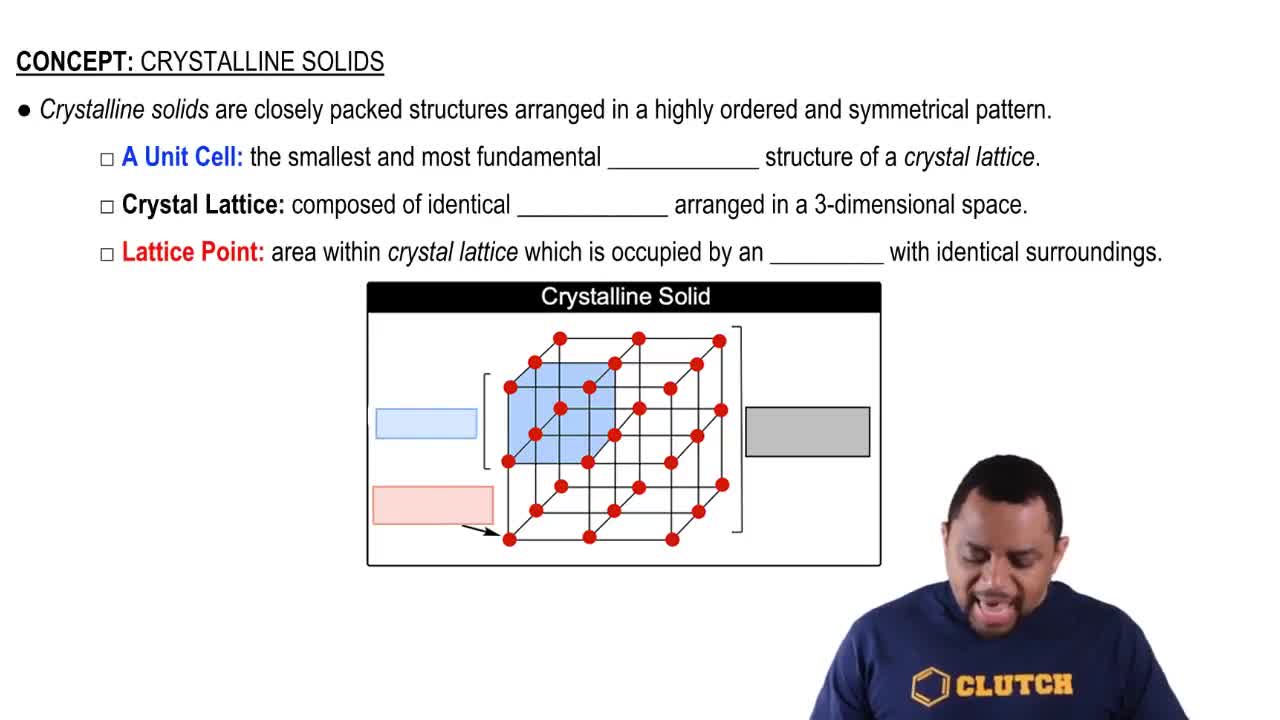
(a) Draw a picture that represents a crystalline solid at the atomic level.

Guida verificata passo dopo passo
1
Step 1: Understand that a crystalline solid is a material whose constituents, such as atoms, molecules, or ions, are arranged in a highly ordered microscopic structure, forming a crystal lattice that extends in all directions.
Step 2: Visualize the crystal lattice as a repeating pattern of unit cells, which are the smallest repeating units that make up the crystal structure.
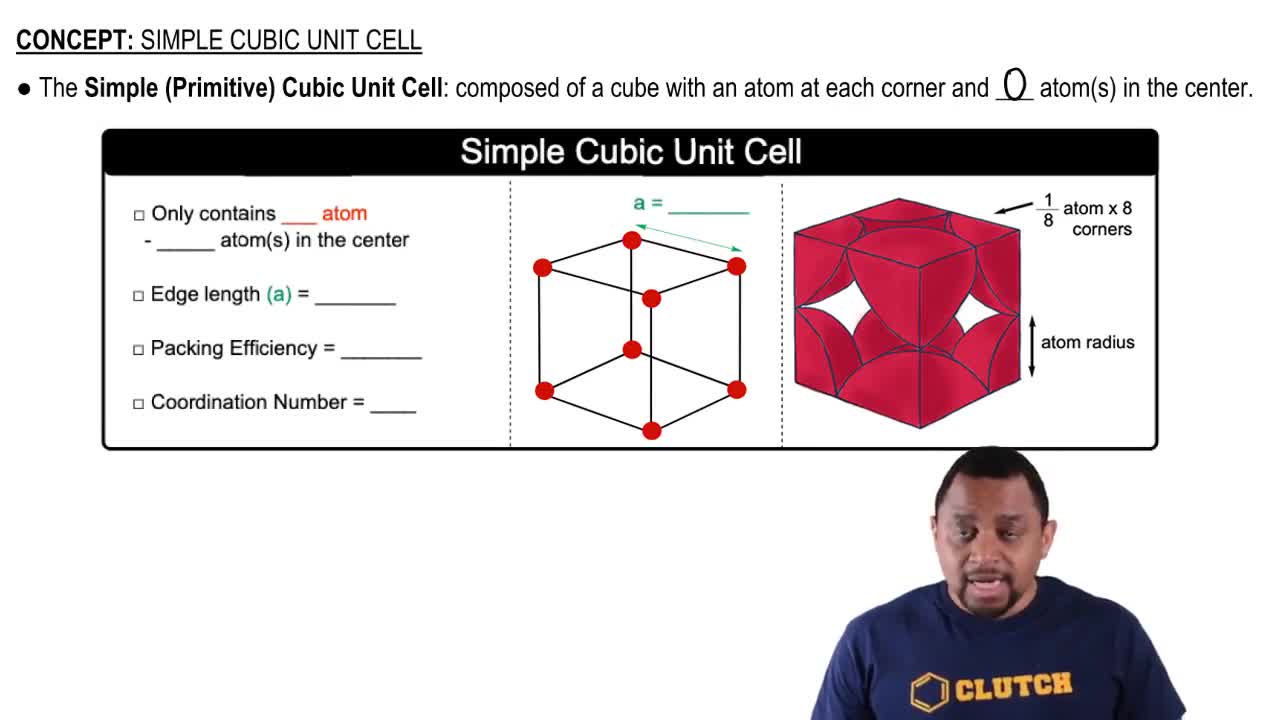
Step 3: Consider a simple cubic lattice, where atoms are located at each corner of a cube. This is one of the simplest types of crystal lattices.
Step 4: Imagine each atom as a sphere, and in a simple cubic lattice, these spheres are arranged in a grid-like pattern, with each sphere touching its neighbors along the edges of the cube.
Step 5: To draw this, sketch a cube and place a sphere at each corner, ensuring that the spheres are evenly spaced and aligned, representing the regular, repeating pattern of a crystalline solid.

Risposta video verificata per un problema simile:

Questa soluzione video è stata consigliata dai nostri tutor come utile per risolvere questo problema.
Durata del video:
36s

Concetti chiave

Ecco i concetti essenziali che devi comprendere per rispondere correttamente alla domanda.

Crystalline Structure

A crystalline structure is a highly ordered arrangement of atoms, ions, or molecules in a solid. This regular pattern extends in three dimensions, forming a lattice that defines the solid's geometric shape. Each point in the lattice represents a position occupied by an atom or a group of atoms, contributing to the solid's stability and unique properties.
Video consigliato:
Percorso guidato
01:31
Crystalline Solids Structure

Unit Cell

The unit cell is the smallest repeating unit of a crystalline structure that, when stacked together, forms the entire crystal lattice. It contains all the essential information about the arrangement of atoms and their positions. Understanding the unit cell is crucial for visualizing and drawing the overall structure of a crystalline solid.
Video consigliato:
Percorso guidato
01:27
Simple Cubic Unit Cell

Atomic Bonding

Atomic bonding refers to the forces that hold atoms together in a solid. In crystalline solids, these bonds can be ionic, covalent, or metallic, depending on the nature of the atoms involved. The type of bonding influences the properties of the solid, such as its melting point, hardness, and electrical conductivity, which are essential to consider when representing the structure at the atomic level.
Video consigliato: