Ch.12 - Solids and Modern Materials
Brown - Chemistry: The Central Science 14th Edition
Brown14th EditionChemistry: The Central ScienceISBN: 9780134414232Non è quello che usi tu?Cambia libro di testo
Capitolo 12, Problema 19b

(b) Now draw a picture that represents an amorphous solid at the atomic level.

Guida verificata passo dopo passo
1
Understand that an amorphous solid lacks a long-range order, unlike crystalline solids which have a repeating pattern.
Visualize the atoms or molecules in an amorphous solid as being arranged randomly, without a definite pattern or structure.
Imagine the atoms or molecules as being closely packed together, but not in a regular, repeating lattice.
Consider that the arrangement might resemble a disordered pile of spheres, where each sphere represents an atom or molecule.
Think about how this lack of order affects the properties of the material, such as having no distinct melting point.

Risposta video verificata per un problema simile:

Questa soluzione video è stata consigliata dai nostri tutor come utile per risolvere questo problema.
Durata del video:
45s

Concetti chiave

Ecco i concetti essenziali che devi comprendere per rispondere correttamente alla domanda.

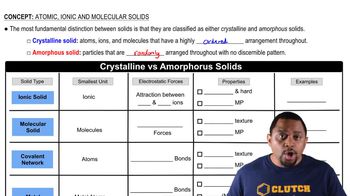
Amorphous Solids

Amorphous solids are materials that lack a long-range order or a well-defined crystalline structure. Unlike crystalline solids, where atoms are arranged in a highly ordered pattern, amorphous solids have a random arrangement of atoms. This disordered structure affects their physical properties, such as melting point and mechanical strength, making them distinct from their crystalline counterparts.
Video consigliato:
Percorso guidato
04:13
Crystalline vs Amorphous Solids

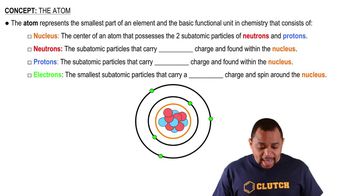
Atomic Structure

The atomic structure refers to the arrangement of atoms within a material. In the context of amorphous solids, this structure is characterized by a lack of periodicity, meaning that the positions of atoms do not repeat in a regular pattern. Understanding atomic structure is crucial for visualizing how atoms interact and bond in different types of solids, influencing their overall properties.
Video consigliato:

Visual Representation of Solids

Visual representation of solids involves creating diagrams or models that depict the arrangement of atoms in a material. For amorphous solids, this representation typically shows a chaotic and irregular distribution of atoms, contrasting with the orderly lattice seen in crystalline solids. Such visualizations help in understanding the unique properties and behaviors of different solid materials.
Video consigliato:
Percorso guidato
01:31
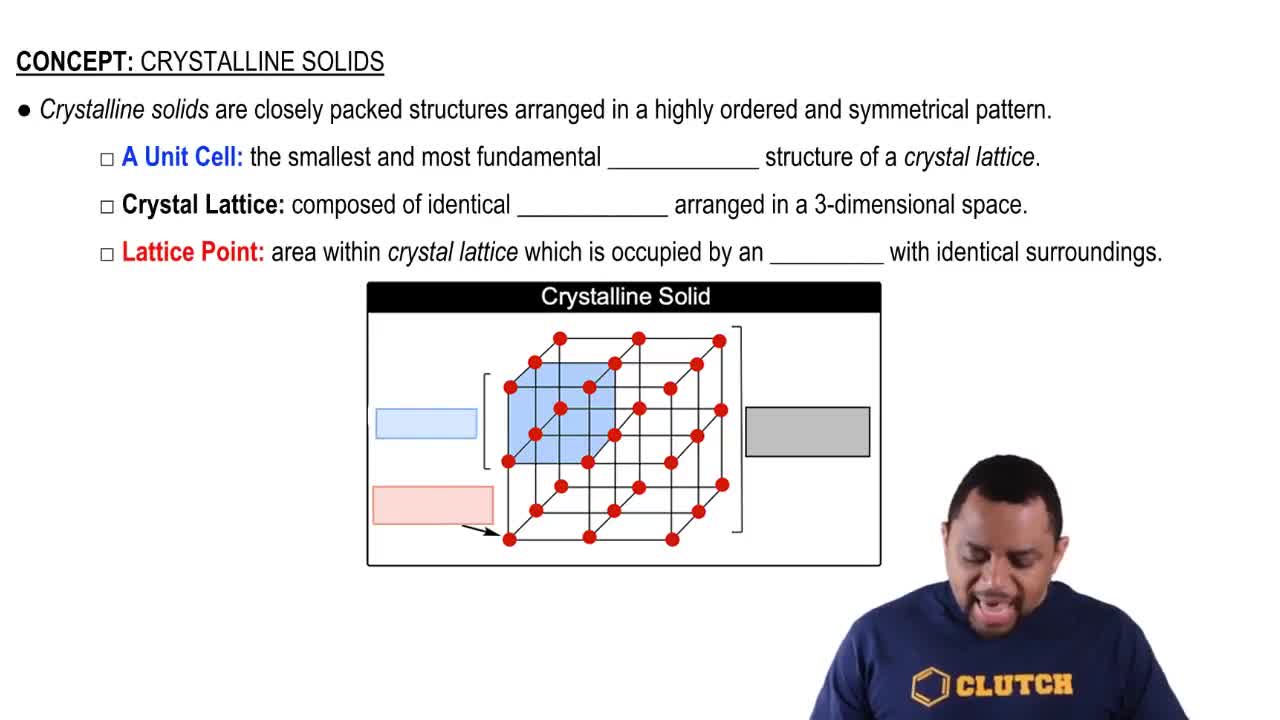
Crystalline Solids Structure