Ch.12 - Solids and Modern Materials
Brown - Chemistry: The Central Science 14th Edition
Brown14th EditionChemistry: The Central ScienceISBN: 9780134414232Non è quello che usi tu?Cambia libro di testo
Capitolo 12, Problema 126a

(a) What are the C—C—C bond angles in diamond?
Diagram showing carbon-carbon bonds in diamond, illustrating bond angles.

Guida verificata passo dopo passo
1
Identify the structure of diamond, which is a three-dimensional network of carbon atoms.
Recognize that each carbon atom in diamond is sp3 hybridized, forming four single covalent bonds with other carbon atoms.
Understand that in an sp3 hybridized carbon, the bond angles are determined by the tetrahedral geometry.
Recall that the ideal bond angle in a tetrahedral geometry is 109.5 degrees.
Conclude that the C-C-C bond angles in diamond are approximately 109.5 degrees.

Risposta video verificata per un problema simile:

Questa soluzione video è stata consigliata dai nostri tutor come utile per risolvere questo problema.
Durata del video:
1m

Concetti chiave

Ecco i concetti essenziali che devi comprendere per rispondere correttamente alla domanda.

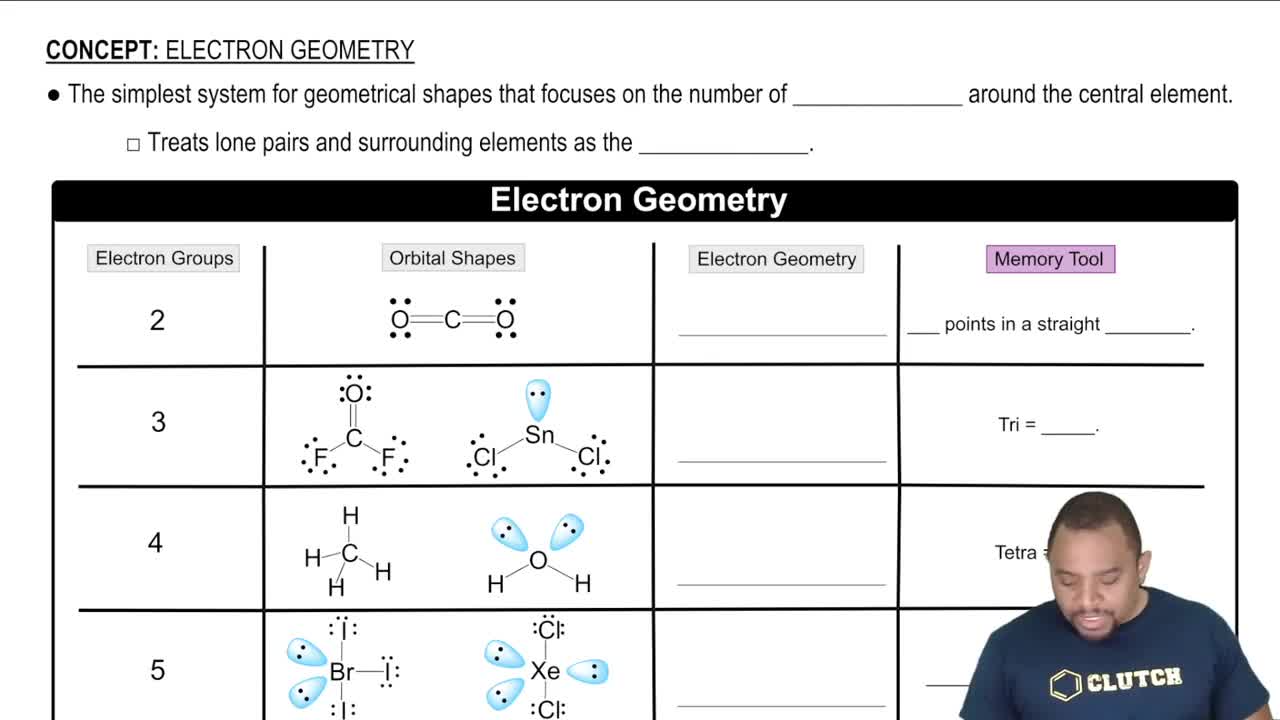
Tetrahedral Geometry

In diamond, each carbon atom is bonded to four other carbon atoms in a tetrahedral arrangement. This geometry arises from the sp3 hybridization of carbon, where the bond angles between the carbon-carbon bonds are approximately 109.5 degrees. This spatial arrangement contributes to the strength and rigidity of the diamond structure.
Video consigliato:
Percorso guidato
04:44
Electron Geometry

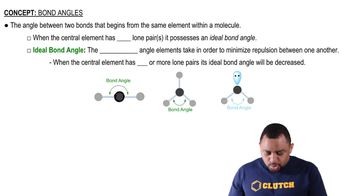
Bond Angles

Bond angles are the angles formed between two bonds that share a common atom. In the case of diamond, the bond angles between the carbon-carbon bonds are crucial for understanding its three-dimensional structure. The tetrahedral bond angles of 109.5 degrees ensure that the carbon atoms are optimally spaced, minimizing electron pair repulsion according to VSEPR theory.
Video consigliato:

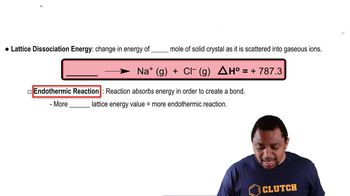
Crystal Lattice Structure

Diamond has a crystal lattice structure, which is a repeating pattern of atoms in three-dimensional space. This arrangement not only defines the bond angles but also contributes to diamond's exceptional hardness and thermal conductivity. The regularity of the lattice allows for uniform bond angles and distances, reinforcing the stability of the material.
Video consigliato: