Ch.12 - Solids and Modern Materials
Brown - Chemistry: The Central Science 14th Edition
Brown14th EditionChemistry: The Central ScienceISBN: 9780134414232Non è quello che usi tu?Cambia libro di testo
Capitolo 12, Problema 128a

Although polyethylene can twist and turn in random ways, the most stable form is a linear one with the carbon backbone oriented as shown in the following figure:
Diagram of a linear polyethylene structure showing carbon and hydroxyl groups.
The solid wedges in the figure indicate bonds from carbon that come out of the plane of the page; the dashed wedges indicate bonds that lie behind the plane of the page. (a) What is the hybridization of orbitals at each carbon atom? What angles do you expect between the bonds?

Guida verificata passo dopo passo
1
Identify the hybridization of each carbon atom in the polyethylene structure. Each carbon atom forms four sigma bonds (single bonds), which indicates sp3 hybridization.
Recall that sp3 hybridization involves the mixing of one s orbital and three p orbitals to form four equivalent sp3 hybrid orbitals.
Determine the bond angles for sp3 hybridized carbon atoms. The ideal bond angle for sp3 hybridization is 109.5 degrees.
Observe the 3D structure of the polyethylene chain. The solid wedges indicate bonds coming out of the plane, and the dashed wedges indicate bonds going behind the plane.
Conclude that each carbon atom in the polyethylene chain is sp3 hybridized, and the bond angles between the carbon atoms are approximately 109.5 degrees.

Risposta video verificata per un problema simile:

Questa soluzione video è stata consigliata dai nostri tutor come utile per risolvere questo problema.
Durata del video:
3m

Concetti chiave

Ecco i concetti essenziali che devi comprendere per rispondere correttamente alla domanda.

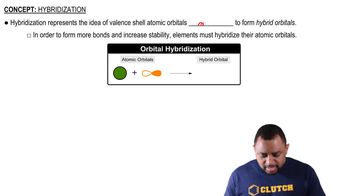
Hybridization

Hybridization is the concept of mixing atomic orbitals to form new hybrid orbitals that can accommodate the bonding requirements of atoms in a molecule. In the case of polyethylene, the carbon atoms undergo sp3 hybridization, where one s orbital and three p orbitals combine to form four equivalent sp3 hybrid orbitals, allowing for tetrahedral geometry around each carbon atom.
Video consigliato:

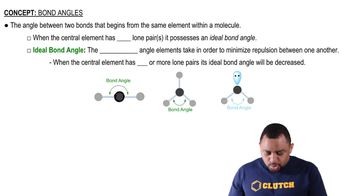
Bond Angles

Bond angles are the angles formed between adjacent bonds in a molecule. For sp3 hybridized carbon atoms, the ideal bond angle is approximately 109.5 degrees, which arises from the tetrahedral arrangement of the hybrid orbitals. This angle minimizes electron pair repulsion, leading to a more stable molecular structure.
Video consigliato:

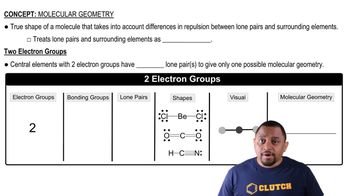
Molecular Geometry

Molecular geometry refers to the three-dimensional arrangement of atoms within a molecule. In linear polyethylene, the carbon backbone is arranged in a straight chain, which influences the physical properties of the polymer. The presence of hydroxyl groups (–OH) also affects the geometry and interactions, contributing to the overall stability and characteristics of the polymer.
Video consigliato:
Percorso guidato
01:33
Molecular Geometry with Two Electron Groups