
Ch.12 - Solids and Modern Materials
Brown - Chemistry: The Central Science 14th Edition
Brown14th EditionChemistry: The Central ScienceISBN: 9780134414232Non è quello che usi tu?Cambia libro di testo
Capitolo 12, Problema 40

An element crystallizes in a face-centered cubic lattice. The edge of the unit cell is 4.078 Å, and the density of the crystal is 19.30 g>cm3. Calculate the atomic weight of the element and identify the element.

Guida verificata passo dopo passo
1
Identify the type of lattice: The problem states that the element crystallizes in a face-centered cubic (FCC) lattice.
Determine the number of atoms per unit cell: In a face-centered cubic lattice, there are 4 atoms per unit cell.
Calculate the volume of the unit cell: Convert the edge length from Ångströms to centimeters (1 Å = 1 x 10^-8 cm) and use the formula for the volume of a cube, V = a^3, where a is the edge length.
Use the density formula to find the mass of the unit cell: Density (d) = mass/volume, rearrange to find mass = density x volume.
Calculate the atomic weight: Use the mass of the unit cell and the number of atoms per unit cell to find the atomic weight. Atomic weight = (mass of unit cell / number of atoms per unit cell) x Avogadro's number.

Risposta video verificata per un problema simile:

Questa soluzione video è stata consigliata dai nostri tutor come utile per risolvere questo problema.
Durata del video:
5m

Concetti chiave

Ecco i concetti essenziali che devi comprendere per rispondere correttamente alla domanda.

Face-Centered Cubic (FCC) Lattice

A face-centered cubic lattice is a type of crystal structure where atoms are located at each corner and the centers of all the cube faces. This arrangement results in a high packing efficiency of about 74%, meaning that a significant volume of the crystal is occupied by atoms. Understanding this structure is crucial for calculating the number of atoms per unit cell, which is essential for determining the atomic weight.
Video consigliato:
Percorso guidato
00:51
Face Centered Cubic Example

Density and Its Relation to Atomic Weight

Density is defined as mass per unit volume and is a critical property in material science. In the context of crystallography, the density of a crystal can be used to derive the atomic weight of the element by using the formula: density = (n * atomic weight) / (V * N_A), where n is the number of atoms per unit cell, V is the volume of the unit cell, and N_A is Avogadro's number. This relationship allows for the calculation of atomic weight from the known density and unit cell dimensions.
Video consigliato:
Percorso guidato
01:38
Atomic Radius and Density of Transition Metals Example

Unit Cell Volume Calculation

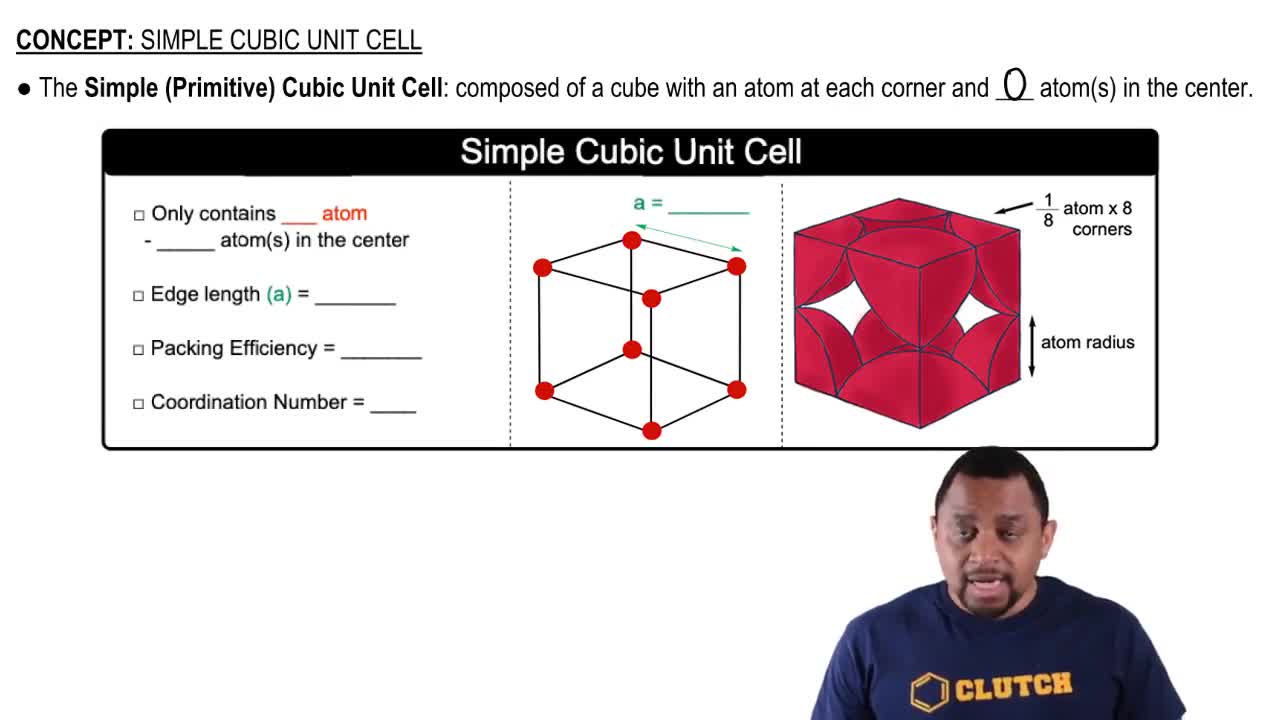
The volume of a unit cell is calculated using the formula V = a^3, where 'a' is the edge length of the cubic cell. For a face-centered cubic lattice, the volume is essential for determining how many atoms are present in the unit cell and subsequently calculating the atomic weight. In this case, with an edge length of 4.078 Å, the volume can be computed to facilitate the density and atomic weight calculations.
Video consigliato:
Percorso guidato
01:27
Simple Cubic Unit Cell