
CdS has a band gap of 2.4 eV. If large crystals of CdS are illuminated with ultraviolet light, they emit light equal to the band gap energy. (b) Would appropriately sized CdS quantum dots be able to emit blue light?
Ch.12 - Solids and Modern Materials
Brown14th EditionChemistry: The Central ScienceISBN: 9780134414232Non è quello che usi tu?Cambia libro di testo
Capitolo 12, Problema 96c
CdS has a band gap of 2.4 eV. If large crystals of CdS are illuminated with ultraviolet light, they emit light equal to the band gap energy. (c) What about red light?
Guida verificata passo dopo passo1
Understand the concept of band gap: The band gap is the energy difference between the valence band and the conduction band in a semiconductor. For CdS, this is 2.4 eV.
Recognize the relationship between light and energy: When a material is illuminated with light, it can absorb photons if the energy of the photons is equal to or greater than the band gap energy.
Consider the energy of red light: Red light has a longer wavelength and therefore lower energy compared to ultraviolet light. The energy of red light is typically less than 2.4 eV.
Determine if red light can excite electrons: Since the energy of red light is less than the band gap energy of CdS, it cannot excite electrons from the valence band to the conduction band.
Conclude the effect of red light on CdS: Red light will not be absorbed by CdS to cause electron excitation, and thus, it will not result in light emission from the material.

Risposta video verificata per un problema simile:
Questa soluzione video è stata consigliata dai nostri tutor come utile per risolvere questo problema.
Durata del video:
3mConcetti chiave
Ecco i concetti essenziali che devi comprendere per rispondere correttamente alla domanda.
Band Gap Energy
The band gap energy is the energy difference between the valence band and the conduction band in a semiconductor or insulator. It determines the wavelengths of light that a material can absorb or emit. For CdS, a band gap of 2.4 eV means it can absorb photons with energy equal to or greater than this value, leading to the emission of light when excited.
Video consigliato:
Percorso guidato
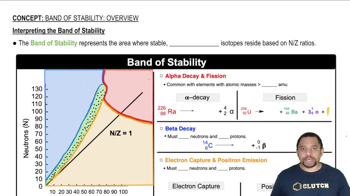
Intepreting the Band of Stability
Photoluminescence
Photoluminescence is the process by which a material absorbs photons and then re-emits them. In the case of CdS, when it is illuminated with ultraviolet light, the absorbed energy excites electrons, which then return to their ground state, emitting light corresponding to the band gap energy. This phenomenon is crucial for understanding how CdS interacts with light.
Color of Light and Energy
The color of light is determined by its wavelength, which is inversely related to its energy. Red light has a longer wavelength and lower energy (around 1.65 eV) compared to the 2.4 eV band gap of CdS. Therefore, CdS cannot emit red light, as the energy of red photons is insufficient to bridge the band gap, meaning it cannot be excited to emit light of that wavelength.
Video consigliato:
Percorso guidato
Photon Energy Example
Pratica correlata
Domanda del libro di testo
383
views
Domanda del libro di testo
Which statement correctly describes a difference between graphene and graphite? (a) Graphene is a molecule but graphite is not. (b) Graphene is a single sheet of carbon atoms and graphite contains many, and larger, sheets of carbon atoms. (c) Graphene is an insulator but graphite is a metal. (d) Graphite is pure carbon but graphene is not. (e) The carbons are sp2 hybridized in graphene but sp3 hybridized in graphite.
833
views
Domanda del libro di testo
CdS has a band gap of 2.4 eV. If large crystals of CdS are illuminated with ultraviolet light, they emit light equal to the band gap energy. (a) What color is the emitted light?
386
views
