


CdS has a band gap of 2.4 eV. If large crystals of CdS are illuminated with ultraviolet light, they emit light equal to the band gap energy. (b) Would appropriately sized CdS quantum dots be able to emit blue light?
Ch.12 - Solids and Modern Materials
Brown14th EditionChemistry: The Central ScienceISBN: 9780134414232Non è quello che usi tu?Cambia libro di testo
Capitolo 12, Problema 95
Explain why “bands” may not be the most accurate description of bonding in a solid when the solid has nanoscale dimensions.
Guida verificata passo dopo passo1
Step 1: Understand the concept of 'bands' in solid-state physics. In bulk solids, atoms are closely packed, and their atomic orbitals overlap to form continuous energy bands, which are crucial for understanding electrical conductivity and other properties.
Step 2: Recognize the impact of nanoscale dimensions. When a solid is reduced to nanoscale dimensions, the number of atoms decreases significantly, leading to fewer overlapping orbitals and discrete energy levels rather than continuous bands.
Step 3: Consider quantum confinement effects. At the nanoscale, quantum confinement becomes significant, altering the electronic properties. The energy levels become quantized, and the band structure is no longer a valid approximation.
Step 4: Explore the implications of discrete energy levels. With discrete energy levels, the electronic properties of nanoscale materials can differ significantly from their bulk counterparts, affecting conductivity, optical properties, and reactivity.
Step 5: Conclude with the limitations of the band theory. The band theory, which works well for bulk materials, may not accurately describe the electronic structure of nanoscale materials due to the lack of continuous energy bands and the presence of quantum effects.
Concetti chiave
Ecco i concetti essenziali che devi comprendere per rispondere correttamente alla domanda.
Quantum Confinement
Quantum confinement occurs when the dimensions of a material are reduced to the nanoscale, leading to discrete energy levels rather than continuous bands. This phenomenon affects the electronic properties of materials, as electrons are restricted in their movement, altering their behavior and interactions compared to bulk materials.
Video consigliato:
Percorso guidato
Quantum Numbers
Band Theory
Band theory describes the range of energy levels that electrons can occupy in a solid. In bulk materials, electrons fill these bands, leading to conductive or insulating properties. However, in nanoscale materials, the simplification of 'bands' may not accurately represent the localized states and energy gaps that arise due to quantum effects.
Video consigliato:
Percorso guidato
Intepreting the Band of Stability
Surface Effects
In nanoscale solids, a significant proportion of atoms are located at or near the surface, which can lead to altered electronic and chemical properties. These surface effects can dominate the behavior of the material, making the traditional band model less applicable, as surface states can introduce new energy levels that influence bonding and reactivity.
Video consigliato:
Percorso guidato
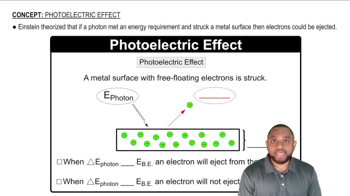
Photoelectric Effect
Pratica correlata
Domanda del libro di testo
383
views
Domanda del libro di testo
CdS has a band gap of 2.4 eV. If large crystals of CdS are illuminated with ultraviolet light, they emit light equal to the band gap energy. (c) What about red light?
243
views
Domanda del libro di testo
CdS has a band gap of 2.4 eV. If large crystals of CdS are illuminated with ultraviolet light, they emit light equal to the band gap energy. (a) What color is the emitted light?
386
views
Domanda del libro di testo
Indicate whether each statement is true or false: (a) Elastomers are rubbery solids. (b) Thermosets cannot be reshaped. (c) Thermoplastic polymers can be recycled.
378
views
Domanda del libro di testo
What molecular structural features cause high-density polyethylene to be denser than low-density polyethylene?
472
views
