Ch.12 - Solids and Modern Materials
Brown - Chemistry: The Central Science 14th Edition
Brown14th EditionChemistry: The Central ScienceISBN: 9780134414232Non è quello che usi tu?Cambia libro di testo
Capitolo 12, Problema 25

Which of the three-dimensional primitive lattices has a unit cell where none of the internal angles is 90? (a) Orthorhombic, (b) hexagonal, (c) rhombohedral, (d) triclinic, (e) both rhombohedral and triclinic.

Guida verificata passo dopo passo
1
Understand the concept of a unit cell in crystallography, which is the smallest repeating unit in a crystal lattice that shows the entire structure's symmetry.
Recognize that a primitive lattice is a type of crystal lattice where each lattice point is occupied by a single atom or molecule.
Recall the characteristics of different types of unit cells: Orthorhombic has all angles at 90 degrees, Hexagonal has two angles at 90 degrees and one at 120 degrees, Rhombohedral has all sides equal and angles equal but not 90 degrees, Triclinic has no angles at 90 degrees, and both Rhombohedral and Triclinic can have none of the internal angles at 90 degrees.
Identify that the question asks for a lattice where none of the internal angles is 90 degrees.
Conclude that the correct options are (d) triclinic and (e) both rhombohedral and triclinic, as these can have unit cells with no 90-degree angles.

Risposta video verificata per un problema simile:

Questa soluzione video è stata consigliata dai nostri tutor come utile per risolvere questo problema.
Durata del video:
5m

Concetti chiave

Ecco i concetti essenziali che devi comprendere per rispondere correttamente alla domanda.

Primitive Lattices

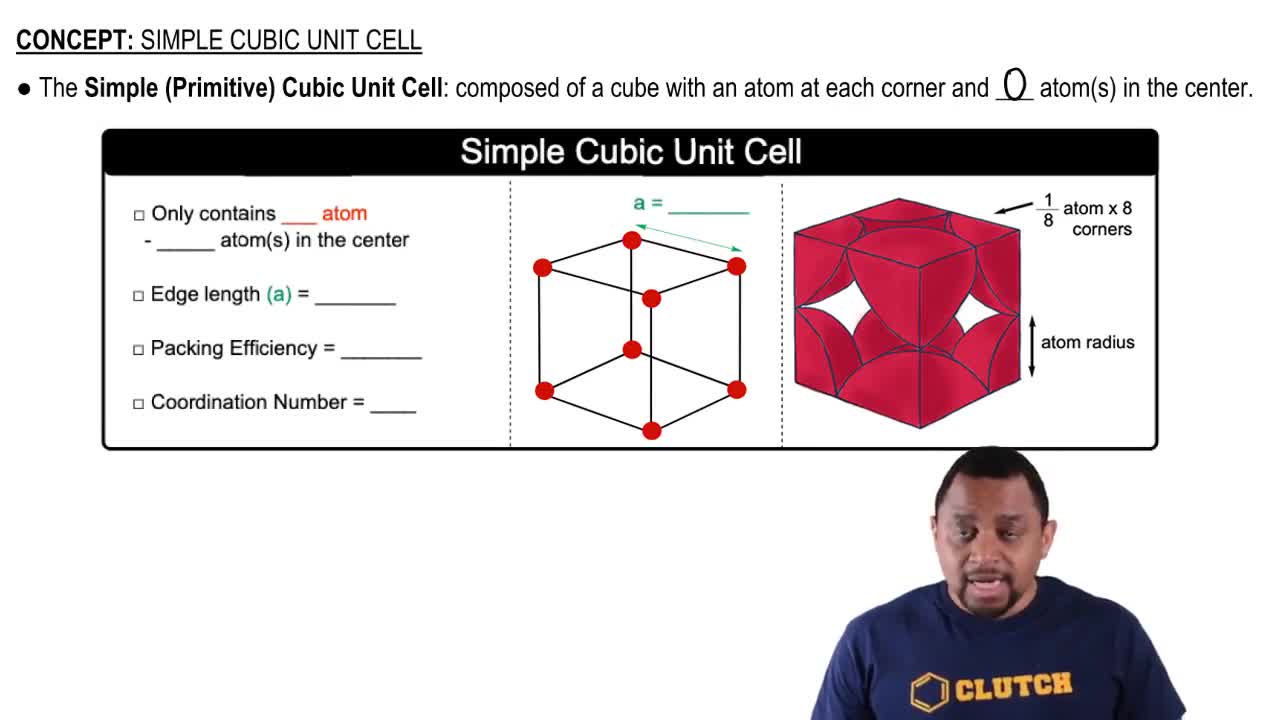
Primitive lattices are the simplest repeating units in a crystal structure, defined by their unit cells. These unit cells can vary in shape and size, and they are characterized by their lattice parameters, which include the lengths of the edges and the angles between them. Understanding the types of primitive lattices is essential for identifying their geometric properties.
Video consigliato:

Unit Cell Angles

The angles between the edges of a unit cell are crucial for classifying crystal systems. In three-dimensional lattices, the internal angles can be 90 degrees or vary, leading to different classifications such as orthorhombic (all angles 90°) or triclinic (no angles 90°). Recognizing these angles helps in determining the symmetry and properties of the crystal structure.
Video consigliato:
Percorso guidato
01:27
Simple Cubic Unit Cell

Crystal Systems

Crystal systems categorize crystals based on their symmetry and lattice parameters. There are seven primary crystal systems, including triclinic and rhombohedral, which are characterized by their unique angles and edge lengths. Understanding these systems is vital for identifying which lattices have non-right angles and for solving related crystallography problems.
Video consigliato:
Percorso guidato
02:06
Entropy of the System