Ch.12 - Solids and Modern Materials
Brown - Chemistry: The Central Science 14th Edition
Brown14th EditionChemistry: The Central ScienceISBN: 9780134414232Non è quello che usi tu?Cambia libro di testo
Capitolo 12, Problema 23

Imagine the primitive cubic lattice. Now imagine grabbing the top of it and stretching it straight up. All angles remain 90. What kind of primitive lattice have you made?
Illustration showing a primitive cubic lattice being stretched into a rectangular prism.

Guida verificata passo dopo passo
1
Identify the initial structure as a primitive cubic lattice, where all sides are equal and all angles are 90 degrees.
Visualize the process of stretching the lattice vertically, which means increasing the height while keeping the base dimensions the same.
Note that the angles remain 90 degrees, so the shape transforms into a rectangular prism.
Recognize that the new lattice structure is a primitive tetragonal lattice, characterized by two equal base dimensions and a different height dimension, with all angles remaining 90 degrees.
Conclude that stretching a primitive cubic lattice vertically while maintaining 90-degree angles results in a primitive tetragonal lattice.

Risposta video verificata per un problema simile:

Questa soluzione video è stata consigliata dai nostri tutor come utile per risolvere questo problema.
Durata del video:
1m

Concetti chiave

Ecco i concetti essenziali che devi comprendere per rispondere correttamente alla domanda.

Primitive Cubic Lattice

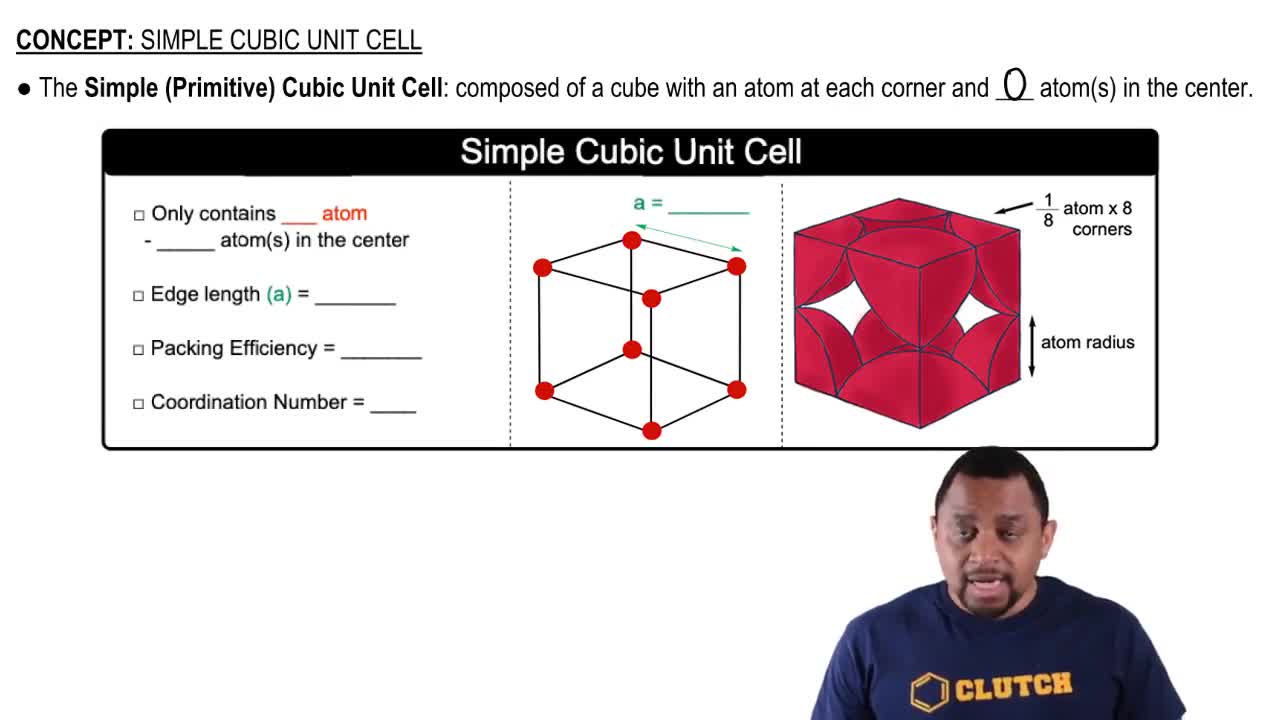
A primitive cubic lattice is a type of crystal structure where atoms are located at the corners of a cube. Each unit cell contains one atom, as the corner atoms are shared among adjacent cells. This arrangement is characterized by its simple geometry and is the basis for understanding more complex lattice structures.
Video consigliato:

Lattice Distortion

Lattice distortion refers to the alteration of the regular arrangement of atoms in a crystal lattice. In this scenario, stretching the primitive cubic lattice vertically while maintaining 90-degree angles transforms it into a rectangular prism, indicating a change in the unit cell dimensions while preserving the overall symmetry of the structure.
Video consigliato:

Unit Cell

The unit cell is the smallest repeating unit in a crystal lattice that reflects the overall symmetry and structure of the entire crystal. In the case of the stretched primitive cubic lattice, the unit cell changes from a cube to a rectangular prism, which affects the properties of the material, such as density and symmetry.
Video consigliato:
Percorso guidato
01:27
Simple Cubic Unit Cell