Ch.13 - Properties of Solutions
Brown - Chemistry: The Central Science 14th Edition
Brown14th EditionChemistry: The Central ScienceISBN: 9780134414232Non è quello che usi tu?Cambia libro di testo
Capitolo 13, Problema 57b

Brass is a substitutional alloy consisting of a solution of copper and zinc. A particular sample of red brass consisting of 80.0 % Cu and 20.0 % Zn by mass has a density of 8750 kg/m3. (b) What is the molarity of Zn in the solution?

Guida verificata passo dopo passo
1
Determine the mass of zinc in a given volume of the brass sample. Assume a convenient volume, such as 1 m^3, for simplicity.
Calculate the mass of zinc in the assumed volume using the percentage composition: \( \text{mass of Zn} = 0.20 \times \text{total mass of brass} \).
Convert the mass of zinc to moles using the molar mass of zinc (65.38 g/mol).
Calculate the volume of the solution in liters. Since the density is given in kg/m^3, convert the volume from m^3 to liters (1 m^3 = 1000 L).
Determine the molarity of zinc by dividing the number of moles of zinc by the volume of the solution in liters.

Risposta video verificata per un problema simile:

Questa soluzione video è stata consigliata dai nostri tutor come utile per risolvere questo problema.
Durata del video:
2m

Concetti chiave

Ecco i concetti essenziali che devi comprendere per rispondere correttamente alla domanda.

Molarity

Molarity is a measure of concentration defined as the number of moles of solute per liter of solution. It is expressed in moles per liter (mol/L) and is crucial for understanding how much of a substance is present in a given volume of solution. To calculate molarity, one must know the mass of the solute, its molar mass, and the total volume of the solution.
Video consigliato:

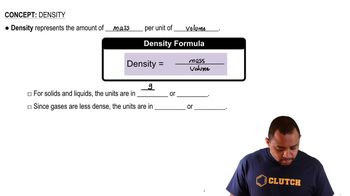
Density

Density is the mass of a substance divided by its volume, typically expressed in kg/m³ or g/cm³. In the context of solutions, density can help determine the mass of solute present in a specific volume of solution. Knowing the density of the brass sample allows for the calculation of the total mass of the solution, which is essential for finding the molarity of the zinc component.
Video consigliato:
Percorso guidato
01:56
Density Concepts

Substitutional Alloys

Substitutional alloys are formed when atoms of the solute metal replace some of the atoms in the solvent metal's crystal lattice. In the case of brass, zinc atoms substitute for copper atoms, affecting the physical properties of the alloy. Understanding the composition of substitutional alloys is important for calculating the proportions of each metal, which is necessary for determining the molarity of the components in the solution.
Video consigliato:
Percorso guidato
01:08
Alcohol Reactions: Substitution Reactions