Commercial concentrated aqueous ammonia is 28% NH3 by mass and has a density of 0.90 g/mL. What is the molarity of this solution?
Ch.13 - Properties of Solutions
Brown14th EditionChemistry: The Central ScienceISBN: 9780134414232Non è quello che usi tu?Cambia libro di testo
Capitolo 13, Problema 57a
Brass is a substitutional alloy consisting of a solution of copper and zinc. A particular sample of red brass consisting of 80.0 % Cu and 20.0 % Zn by mass has a density of 8750 kg/m3. (a) What is the molality of Zn in the solid solution?
Guida verificata passo dopo passo1
Calculate the mass of zinc in 1 kg of the brass sample. Since the sample is 20.0% Zn by mass, the mass of Zn is 0.20 kg.
Calculate the mass of copper in 1 kg of the brass sample. Since the sample is 80.0% Cu by mass, the mass of Cu is 0.80 kg.
Determine the number of moles of Zn using its molar mass (65.38 g/mol). Convert the mass of Zn from kg to g before using the formula: moles = mass (g) / molar mass (g/mol).
Determine the number of moles of Cu using its molar mass (63.55 g/mol). Convert the mass of Cu from kg to g before using the formula: moles = mass (g) / molar mass (g/mol).
Calculate the molality of Zn in the solution using the formula: molality (m) = moles of solute (Zn) / mass of solvent (Cu) in kg.

Risposta video verificata per un problema simile:
Questa soluzione video è stata consigliata dai nostri tutor come utile per risolvere questo problema.
Durata del video:
3mConcetti chiave
Ecco i concetti essenziali che devi comprendere per rispondere correttamente alla domanda.
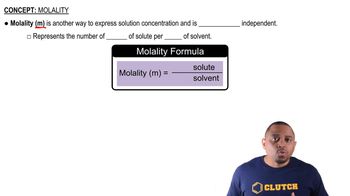
Molality
Molality is a measure of the concentration of a solute in a solution, defined as the number of moles of solute per kilogram of solvent. It is particularly useful in situations where temperature changes may affect volume, as it is based on mass rather than volume. In this case, calculating the molality of zinc (Zn) in the brass alloy requires knowing the mass of the solvent, which is the copper (Cu) in the alloy.
Video consigliato:
Percorso guidato
Molality
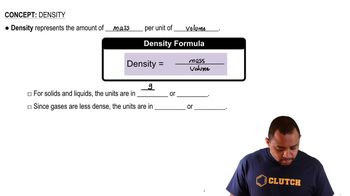
Density
Density is defined as mass per unit volume and is a critical property for understanding the composition of materials. In the context of the brass alloy, the given density allows for the conversion between mass and volume, which is essential for determining the amounts of copper and zinc present in the sample. Knowing the density helps in calculating the total mass of the alloy, which is necessary for further calculations.
Video consigliato:
Percorso guidato
Density Concepts
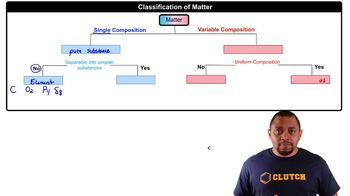
Alloy Composition
An alloy is a mixture of two or more elements, where at least one is a metal, and its properties differ from those of its constituent elements. In this case, brass is a substitutional alloy of copper and zinc, meaning that zinc atoms replace some of the copper atoms in the metallic lattice. Understanding the composition of the alloy is crucial for calculating the molality, as it directly influences the amounts of each metal present in the sample.
Video consigliato:
Percorso guidato
Matter Composition
Pratica correlata
Domanda del libro di testo
13
views
Domanda del libro di testo
Commercial concentrated aqueous ammonia is 28% NH3 by mass and has a density of 0.90 g/mL. What is the molarity of this solution?
2228
views
Domanda del libro di testo
Commercial aqueous nitric acid has a density of 1.42 g/mL and is 16 M. Calculate the percent HNO3 by mass in the solution.
2791
views
1
comments
Domanda del libro di testo
Brass is a substitutional alloy consisting of a solution of copper and zinc. A particular sample of red brass consisting of 80.0 % Cu and 20.0 % Zn by mass has a density of 8750 kg/m3. (b) What is the molarity of Zn in the solution?
966
views
Domanda del libro di testo
Caffeine (C8H10N4O2) is a stimulant found in coffee and tea. If a solution of caffeine in the solvent chloroform (CHCl3) has a concentration of 0.0500 m, calculate (b) the mole fraction of caffeine in the solution.
837
views