
Ch.13 - Properties of Solutions
Brown - Chemistry: The Central Science 14th Edition
Brown14th EditionChemistry: The Central ScienceISBN: 9780134414232Non è quello che usi tu?Cambia libro di testo
Capitolo 13, Problema 104b

Carbon disulfide (CS2) boils at 46.30 °C and has a density of 1.261 g/mL. (b) When 5.39 g of a nondissociating unknown is dissolved in 50.0 mL of CS2, the solution boils at 47.08 °C. What is the molar mass of the unknown?

Guida verificata passo dopo passo
1
First, identify the boiling point elevation formula: ΔT_b = i * K_b * m, where ΔT_b is the boiling point elevation, i is the van't Hoff factor (which is 1 for a nondissociating solute), K_b is the ebullioscopic constant of the solvent, and m is the molality of the solution.
Calculate the boiling point elevation (ΔT_b) by subtracting the boiling point of pure CS2 from the boiling point of the solution: ΔT_b = 47.08 °C - 46.30 °C.
Determine the molality (m) of the solution using the formula: m = moles of solute / kg of solvent. First, convert the volume of CS2 to mass using its density: mass of CS2 = 50.0 mL * 1.261 g/mL.
Rearrange the boiling point elevation formula to solve for the molality: m = ΔT_b / (i * K_b). Use the calculated ΔT_b and the known K_b for CS2 to find the molality.
Finally, calculate the molar mass of the unknown solute using the formula: molar mass = mass of solute / moles of solute. Use the mass of the solute (5.39 g) and the moles of solute obtained from the molality calculation.

Risposta video verificata per un problema simile:

Questa soluzione video è stata consigliata dai nostri tutor come utile per risolvere questo problema.
Durata del video:
4m

Concetti chiave

Ecco i concetti essenziali che devi comprendere per rispondere correttamente alla domanda.

Boiling Point Elevation

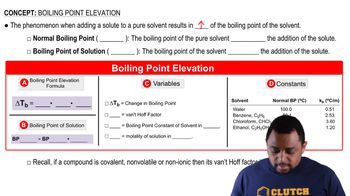
Boiling point elevation is a colligative property that describes how the boiling point of a solvent increases when a solute is dissolved in it. This phenomenon occurs because the presence of solute particles disrupts the formation of vapor above the liquid, requiring a higher temperature to reach the boiling point. The change in boiling point can be calculated using the formula ΔT_b = i * K_b * m, where ΔT_b is the boiling point elevation, i is the van 't Hoff factor, K_b is the ebullioscopic constant of the solvent, and m is the molality of the solution.
Video consigliato:
Percorso guidato
03:05
Boiling Point Elevation

Molality

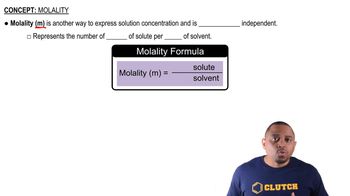
Molality (m) is a measure of the concentration of a solute in a solution, defined as the number of moles of solute per kilogram of solvent. It is particularly useful in colligative property calculations because it is independent of temperature and volume changes. To calculate molality, one must first determine the number of moles of the solute and the mass of the solvent in kilograms, which allows for accurate determination of the solution's properties.
Video consigliato:

Molar Mass Calculation

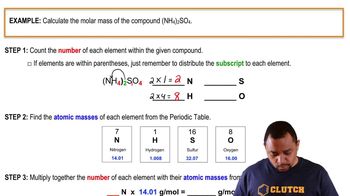
Molar mass is the mass of one mole of a substance, typically expressed in grams per mole (g/mol). To find the molar mass of an unknown solute, one can use the relationship between the mass of the solute, the change in boiling point, and the molality of the solution. By rearranging the boiling point elevation formula and substituting known values, one can solve for the molar mass, which is essential for identifying the unknown substance.
Video consigliato:
Percorso guidato
03:12
Molar Mass Calculation Example