


Ch.13 - Properties of Solutions
Brown - Chemistry: The Central Science 14th Edition
Brown14th EditionChemistry: The Central ScienceISBN: 9780134414232Non è quello che usi tu?Cambia libro di testo
Capitolo 13, Problema 106a

Fluorocarbons (compounds that contain both carbon and fluorine) were, until recently, used as refrigerants. The compounds listed in the following table are all gases at 25 °C, and their solubilities in water at 25 °C and 1 atm fluorocarbon pressure are given as mass percentages. (a) For each fluorocarbon, calculate the molality of a saturated solution.

Guida verificata passo dopo passo
1
Step 1: Understand the problem and gather necessary information. You are given the solubility of each fluorocarbon in water as a mass percentage. You need to convert this information into molality, which is defined as moles of solute per kilogram of solvent.
Step 2: Convert the mass percentage to grams of solute and solvent. Assume you have 100 grams of solution. The mass percentage tells you how many grams of the fluorocarbon are present in 100 grams of solution.
Step 3: Calculate the mass of the solvent (water) in the solution. Subtract the mass of the fluorocarbon (from Step 2) from the total mass of the solution (100 grams) to find the mass of the water.
Step 4: Convert the mass of the fluorocarbon to moles. Use the molar mass of the fluorocarbon to convert the mass of the fluorocarbon (from Step 2) to moles.
Step 5: Calculate the molality. Divide the number of moles of fluorocarbon (from Step 4) by the mass of the solvent in kilograms (from Step 3) to find the molality of the solution.

Risposta video verificata per un problema simile:

Questa soluzione video è stata consigliata dai nostri tutor come utile per risolvere questo problema.
Durata del video:
6m

Concetti chiave

Ecco i concetti essenziali che devi comprendere per rispondere correttamente alla domanda.

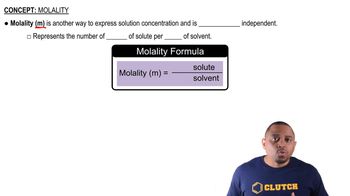
Molality

Molality is a measure of the concentration of a solute in a solution, defined as the number of moles of solute per kilogram of solvent. It is particularly useful in situations where temperature changes may affect the volume of the solution, as it is based on mass rather than volume. To calculate molality, one must know the mass of the solute and the mass of the solvent, allowing for accurate concentration measurements in various chemical contexts.
Video consigliato:

Saturated Solution

A saturated solution is one in which the maximum amount of solute has been dissolved in a solvent at a given temperature and pressure. Beyond this point, any additional solute will not dissolve and will remain as a solid. Understanding saturation is crucial for calculating molality, as it determines the amount of solute present in the solution, which is necessary for further concentration calculations.
Video consigliato:
Percorso guidato
01:11
Types of Aqueous Solutions

Solubility

Solubility refers to the ability of a substance (solute) to dissolve in a solvent at a specific temperature and pressure, often expressed in terms of mass percentage or molarity. In the context of fluorocarbons, solubility indicates how much of the gas can be dissolved in water, which is essential for determining the concentration of the solution. This property is influenced by factors such as temperature, pressure, and the nature of the solute and solvent.
Video consigliato:
Percorso guidato
00:28
Solubility Rules
Pratica correlata
Domanda del libro di testo

Carbon disulfide (CS2) boils at 46.30 °C and has a density of 1.261 g/mL. (a) When 0.250 mol of a nondissociating solute is dissolved in 400.0 mL of CS2, the solution boils at 47.46 °C. What is the molal boiling-point-elevation constant for CS2?

1038
views
1
rank
Domanda del libro di testo

Fluorocarbons (compounds that contain both carbon and fluorine) were, until recently, used as refrigerants. The compounds listed in the following table are all gases at 25 °C, and their solubilities in water at 25 °C and 1 atm fluorocarbon pressure are given as mass percentages. (c) Infants born with severe respiratory problems are sometimes given liquid ventilation: They breathe a liquid that can dissolve more oxygen than air can hold. One of these liquids is a fluorinated compound, CF3(CF2)7Br. The solubility of oxygen in this liquid is 66 mL O2 per 100 mL liquid. In contrast, air is 21% oxygen by volume. Calculate the moles of O2 present in an infant’s lungs (volume: 15 mL) if the infant takes a full breath of air compared to taking a full “breath” of a saturated solution of O2 in the fluorinated liquid. Assume a pressure of 1 atm in the lungs.

553
views
Domanda del libro di testo

Fluorocarbons (compounds that contain both carbon and fluorine) were, until recently, used as refrigerants. The compounds listed in the following table are all gases at 25 °C, and their solubilities in water at 25 °C and 1 atm fluorocarbon pressure are given as mass percentages. (b) Which molecular property best predicts the solubility of these gases in water: molar mass, dipole moment, or ability to hydrogen-bond to water?

Fluorocarbon Solubility (mass %)

CF4 0.0015

CClF3 0.009

CCl2F2 0.028

CHClF2 0.30

Domanda del libro di testo

Carbon disulfide (CS2) boils at 46.30 °C and has a density of 1.261 g/mL. (b) When 5.39 g of a nondissociating unknown is dissolved in 50.0 mL of CS2, the solution boils at 47.08 °C. What is the molar mass of the unknown?

2
views