


Ch.13 - Properties of Solutions
Brown - Chemistry: The Central Science 14th Edition
Brown14th EditionChemistry: The Central ScienceISBN: 9780134414232Non è quello che usi tu?Cambia libro di testo
Capitolo 13, Problema 106c

Fluorocarbons (compounds that contain both carbon and fluorine) were, until recently, used as refrigerants. The compounds listed in the following table are all gases at 25 °C, and their solubilities in water at 25 °C and 1 atm fluorocarbon pressure are given as mass percentages. (c) Infants born with severe respiratory problems are sometimes given liquid ventilation: They breathe a liquid that can dissolve more oxygen than air can hold. One of these liquids is a fluorinated compound, CF3(CF2)7Br. The solubility of oxygen in this liquid is 66 mL O2 per 100 mL liquid. In contrast, air is 21% oxygen by volume. Calculate the moles of O2 present in an infant’s lungs (volume: 15 mL) if the infant takes a full breath of air compared to taking a full “breath” of a saturated solution of O2 in the fluorinated liquid. Assume a pressure of 1 atm in the lungs.

Guida verificata passo dopo passo
1
Calculate the volume of oxygen in a full breath of air: Since air is 21% oxygen by volume, multiply the total lung volume (15 mL) by 0.21 to find the volume of oxygen in the air.
Convert the volume of oxygen in air to moles: Use the ideal gas law equation, PV = nRT, where P is pressure (1 atm), V is volume in liters, R is the ideal gas constant (0.0821 L·atm/mol·K), and T is temperature in Kelvin (298 K). Rearrange to solve for n (moles of O_2).
Calculate the volume of oxygen in a full 'breath' of the fluorinated liquid: Given that the solubility of oxygen is 66 mL O_2 per 100 mL of liquid, find the volume of oxygen in 15 mL of the liquid by setting up a proportion.
Convert the volume of oxygen in the fluorinated liquid to moles: Again, use the ideal gas law equation, PV = nRT, to find the moles of oxygen, using the volume of oxygen calculated in the previous step.
Compare the moles of oxygen from air and the fluorinated liquid: Analyze which method of breathing provides more moles of oxygen to the infant's lungs.

Risposta video verificata per un problema simile:

Questa soluzione video è stata consigliata dai nostri tutor come utile per risolvere questo problema.
Durata del video:
5m

Concetti chiave

Ecco i concetti essenziali che devi comprendere per rispondere correttamente alla domanda.

Gas Laws

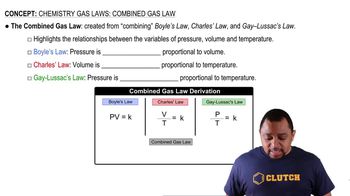
Gas laws describe the behavior of gases in relation to pressure, volume, and temperature. Key laws include Boyle's Law, which states that pressure and volume are inversely related at constant temperature, and Charles's Law, which states that volume is directly proportional to temperature at constant pressure. Understanding these laws is essential for calculating the behavior of gases, such as oxygen in the lungs, under varying conditions.
Video consigliato:
Percorso guidato
01:43
Combined Gas Law

Solubility and Concentration

Solubility refers to the maximum amount of a substance that can dissolve in a solvent at a given temperature and pressure. In this context, the solubility of oxygen in the fluorinated liquid is crucial for determining how much oxygen can be available for respiration. Concentration, often expressed in terms of moles per volume, helps quantify the amount of dissolved gas, which is necessary for comparing the oxygen available in air versus the liquid.
Video consigliato:
Percorso guidato
00:28
Solubility Rules

Mole Concept

The mole is a fundamental unit in chemistry that quantifies the amount of substance. One mole contains approximately 6.022 x 10²³ entities (atoms, molecules, etc.). In this question, calculating the moles of O₂ in the lungs requires converting the volume of gas (in mL) to moles using the ideal gas law or molar volume at standard conditions, which is essential for comparing the amounts of oxygen from air and the fluorinated liquid.
Video consigliato:
Pratica correlata
Domanda del libro di testo

At ordinary body temperature (37 °C), the solubility of N2 in water at ordinary atmospheric pressure (1.0 atm) is 0.015 g/L. Air is approximately 78 mol % N2. (b) At a depth of 100 ft in water, the external pressure is 4.0 atm. What is the solubility of N2 from air in blood at this pressure?

1286
views
1
comments
Domanda del libro di testo

Fluorocarbons (compounds that contain both carbon and fluorine) were, until recently, used as refrigerants. The compounds listed in the following table are all gases at 25 °C, and their solubilities in water at 25 °C and 1 atm fluorocarbon pressure are given as mass percentages. (a) For each fluorocarbon, calculate the molality of a saturated solution.

436
views
Domanda del libro di testo
A series of anions is shown below:

The anion on the far right is called 'BARF' by chemists, as its common abbreviation sounds similar to this word. (d) Tetrabutylammonium, (CH3CH2CH2CH2)4N + is a bulky cation. Which anion, when paired with the tetrabutylammonium cation, would lead to a salt that will be most soluble in nonpolar solvents?
585
views
Domanda del libro di testo

Fluorocarbons (compounds that contain both carbon and fluorine) were, until recently, used as refrigerants. The compounds listed in the following table are all gases at 25 °C, and their solubilities in water at 25 °C and 1 atm fluorocarbon pressure are given as mass percentages. (b) Which molecular property best predicts the solubility of these gases in water: molar mass, dipole moment, or ability to hydrogen-bond to water?

Fluorocarbon Solubility (mass %)

CF4 0.0015

CClF3 0.009

CCl2F2 0.028

CHClF2 0.30