Ch.13 - Properties of Solutions
Brown - Chemistry: The Central Science 14th Edition
Brown14th EditionChemistry: The Central ScienceISBN: 9780134414232Non è quello che usi tu?Cambia libro di testo
Capitolo 13, Problema 72

List the following aqueous solutions in order of decreasing freezing point: 0.040 m glycerin (C3H8O3), 0.020 m KBr, 0.030 m phenol (C6H5OH).

Guida verificata passo dopo passo
1
Step 1: Understand that the freezing point of a solution is affected by the number of solute particles in the solution, which is described by the colligative property known as freezing point depression.
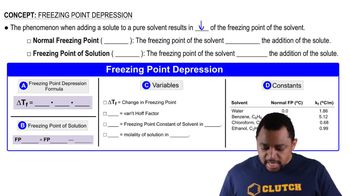
Step 2: Recall the formula for freezing point depression: \( \Delta T_f = i \cdot K_f \cdot m \), where \( \Delta T_f \) is the change in freezing point, \( i \) is the van't Hoff factor, \( K_f \) is the freezing point depression constant, and \( m \) is the molality of the solution.
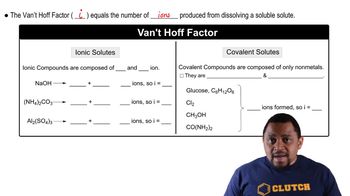
Step 3: Determine the van't Hoff factor \( i \) for each solute: Glycerin (C3H8O3) is a non-electrolyte, so \( i = 1 \); KBr is an electrolyte that dissociates into K+ and Br-, so \( i = 2 \); Phenol (C6H5OH) is a weak electrolyte, but for simplicity, assume \( i = 1 \).
Step 4: Calculate the effective molality for each solution by multiplying the molality by the van't Hoff factor: Glycerin: \( 0.040 \times 1 = 0.040 \), KBr: \( 0.020 \times 2 = 0.040 \), Phenol: \( 0.030 \times 1 = 0.030 \).
Step 5: Rank the solutions in order of decreasing freezing point. The solution with the lowest effective molality will have the highest freezing point. Therefore, the order is: Phenol (0.030 m), Glycerin (0.040 m), KBr (0.040 m).

Concetti chiave

Ecco i concetti essenziali che devi comprendere per rispondere correttamente alla domanda.

Freezing Point Depression

Freezing point depression is a colligative property that describes how the freezing point of a solvent decreases when a solute is added. The extent of this depression depends on the number of solute particles in solution rather than their identity. This means that solutions with more dissolved particles will have lower freezing points.
Video consigliato:
Percorso guidato
01:59
Freezing Point Depression

Van't Hoff Factor (i)

The Van't Hoff factor (i) indicates the number of particles into which a solute dissociates in solution. For example, KBr dissociates into two ions (K+ and Br-), giving it an i value of 2, while non-electrolytes like glycerin and phenol do not dissociate, so their i values are 1. This factor is crucial for calculating the effective concentration of solute particles affecting freezing point.
Video consigliato:
Percorso guidato
02:50
Van't Hoff Factor

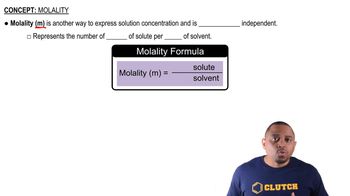
Molality (m)

Molality is a measure of concentration defined as the number of moles of solute per kilogram of solvent. It is particularly useful in colligative property calculations because it directly relates to the number of solute particles in a given mass of solvent. In this question, the molalities of the solutions will help determine their respective freezing point depressions.
Video consigliato: