
Ch.13 - Properties of Solutions
Brown - Chemistry: The Central Science 14th Edition
Brown14th EditionChemistry: The Central ScienceISBN: 9780134414232Non è quello che usi tu?Cambia libro di testo
Capitolo 13, Problema 62b

You make a solution of a nonvolatile solute with a liquid solvent. Indicate if each of the following statements is true or false. (b) The solid that forms as the solution freezes is nearly pure solute.

Guida verificata passo dopo passo
1
insert step 1> Identify the components of the solution: a nonvolatile solute and a liquid solvent.
insert step 2> Understand the process of freezing: as the solution cools, the solvent molecules begin to form a solid structure (crystal lattice).
insert step 3> Consider the nature of the solute: since it is nonvolatile, it does not easily escape into the vapor phase, but it can still be excluded from the solid structure formed by the solvent.
insert step 4> Recognize that during freezing, the solvent molecules preferentially form the solid phase, often excluding the solute molecules, leading to a solid that is nearly pure solvent.
insert step 5> Conclude that the statement is false because the solid that forms as the solution freezes is nearly pure solvent, not solute.

Risposta video verificata per un problema simile:

Questa soluzione video è stata consigliata dai nostri tutor come utile per risolvere questo problema.
Durata del video:
1m

Concetti chiave

Ecco i concetti essenziali che devi comprendere per rispondere correttamente alla domanda.

Nonvolatile Solute

A nonvolatile solute is a substance that does not readily evaporate at room temperature and has a low vapor pressure compared to the solvent. When dissolved in a solvent, it affects the physical properties of the solution, such as lowering the freezing point. This property is crucial in understanding how solutes influence the freezing behavior of solutions.
Video consigliato:
Percorso guidato
01:39
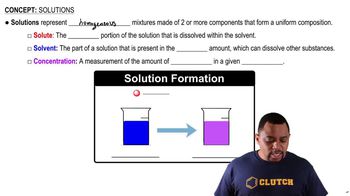
Solution Components

Freezing Point Depression

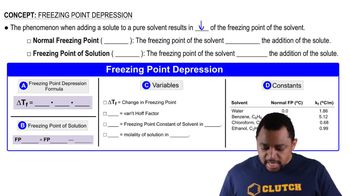
Freezing point depression is a colligative property that describes how the addition of a solute to a solvent lowers the temperature at which the solvent freezes. This phenomenon occurs because solute particles disrupt the formation of the solid lattice structure of the solvent, requiring a lower temperature to achieve solidification. Understanding this concept is essential for predicting the behavior of solutions upon freezing.
Video consigliato:
Percorso guidato
01:59
Freezing Point Depression

Purity of Crystallized Solute

When a solution freezes, the solid that forms is typically composed of the solvent in a crystalline structure, while the solute remains dissolved in the liquid phase. In the case of a nonvolatile solute, the solid that forms is not pure solute; instead, it is primarily the solvent, with the solute remaining in the unfrozen solution. This concept is important for understanding the composition of solids formed from solutions.
Video consigliato:
Percorso guidato
01:39
Solution Components