Ch.14 - Chemical Kinetics
Brown - Chemistry: The Central Science 14th Edition
Brown14th EditionChemistry: The Central ScienceISBN: 9780134414232Non è quello che usi tu?Cambia libro di testo
Capitolo 14, Problema 88

Suppose that a certain biologically important reaction is quite slow at physiological temperature 137 _x001E_C2 in the absence of a catalyst. Assuming that the collision factor remains the same, by how much must an enzyme lower the activation energy of the reaction to achieve a 1 * 10^5-fold increase in the reaction rate?

Guida verificata passo dopo passo
1
Step 1: Understand the Arrhenius equation, which relates the rate constant k of a reaction to the temperature T and the activation energy E_a: k = A * e^(-E_a/(RT)), where A is the pre-exponential factor, R is the gas constant, and T is the temperature in Kelvin.
Step 2: Recognize that the problem asks for the change in activation energy (ΔE_a) needed to increase the reaction rate by a factor of 1 * 10^5. This means the new rate constant k' is 1 * 10^5 times the original rate constant k.
Step 3: Set up the ratio of the new rate constant to the original rate constant using the Arrhenius equation: k'/k = (A * e^(-E_a'/(RT))) / (A * e^(-E_a/(RT))) = e^((E_a - E_a')/(RT)).
Step 4: Substitute the given rate increase factor into the equation: 1 * 10^5 = e^((E_a - E_a')/(RT)).
Step 5: Solve for the change in activation energy ΔE_a = E_a - E_a' by taking the natural logarithm of both sides: ΔE_a = RT * ln(1 * 10^5).

Concetti chiave

Ecco i concetti essenziali che devi comprendere per rispondere correttamente alla domanda.

Activation Energy

Activation energy is the minimum energy required for a chemical reaction to occur. It represents a barrier that reactants must overcome to transform into products. Lowering the activation energy increases the likelihood of successful collisions between reactant molecules, thereby accelerating the reaction rate.
Video consigliato:
Percorso guidato
02:02
Activity Series Chart

Enzymes as Catalysts

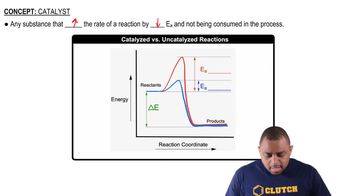
Enzymes are biological catalysts that speed up chemical reactions by lowering the activation energy. They achieve this by providing an alternative reaction pathway and stabilizing the transition state. Enzymes are highly specific and can significantly enhance reaction rates, often by several orders of magnitude.
Video consigliato:
Percorso guidato
01:59
Catalyzed vs. Uncatalyzed Reactions

Arrhenius Equation

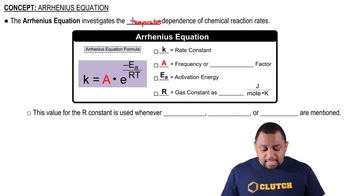
The Arrhenius equation describes the temperature dependence of reaction rates and relates the rate constant to activation energy. It is expressed as k = A * e^(-Ea/RT), where k is the rate constant, A is the pre-exponential factor, Ea is the activation energy, R is the gas constant, and T is the temperature in Kelvin. This equation illustrates how a decrease in activation energy leads to an exponential increase in reaction rate.
Video consigliato:
Percorso guidato
01:20
Arrhenius Equation
Pratica correlata
Domanda del libro di testo

Consider the reaction A + B → C + D. Is each of the following statements true or false? (b) If the reaction is an elementary reaction, the rate law is second order.

374
views

Domanda del libro di testo

The activation energy of an uncatalyzed reaction is 95 kJ/mol. The addition of a catalyst lowers the activation energy to 55 kJ/mol. Assuming that the collision factor remains the same, by what factor will the catalyst increase the rate of the reaction at (a) 25 C

4097
views
1
rank
Domanda del libro di testo

The enzyme urease catalyzes the reaction of urea, (NH2CONH2), with water to produce carbon dioxide and ammonia. In water, without the enzyme, the reaction proceeds with a first-order rate constant of 4.15 × 10⁻⁵ s-1 at 100°C. In the presence of the enzyme in water, the reaction proceeds with a rate constant of 3.4 × 10⁴ s-1 at 21°C. (c) In actuality, what would you expect for the rate of the catalyzed reaction at 100°C as compared to that at 21°C?

2129
views
Domanda del libro di testo

Consider the reaction A + B → C + D. Is each of the following statements true or false? (c) If the reaction is an elementary reaction, the rate law of the reverse reaction is first order.

776
views
Domanda del libro di testo

The activation energy of an uncatalyzed reaction is 95 kJ/mol. The addition of a catalyst lowers the activation energy to 55 kJ/mol. Assuming that the collision factor remains the same, by what factor will the catalyst increase the rate of the reaction at (b) 125 °C?

1218
views