
Ch.14 - Chemical Kinetics
Brown - Chemistry: The Central Science 14th Edition
Brown14th EditionChemistry: The Central ScienceISBN: 9780134414232Non è quello che usi tu?Cambia libro di testo
Capitolo 14, Problema 72a

The decomposition of hydrogen peroxide is catalyzed by iodide ion. The catalyzed reaction is thought to proceed by a two-step mechanism:
H2O2(aq) + I-(aq) → H2O(l) + IO-(aq) (slow)
IO-(aq) + H2O2(aq) → H2O(l) + O2(g) + I-(aq) (fast)
(a) Write the chemical equation for the overall process.

Guida verificata passo dopo passo
1
Identify the reactants and products in each step of the mechanism. In the first step, the reactants are H\(_2\)O\(_2\) and I$^-$, and the products are H\(_2\)O and IO$^-$. In the second step, the reactants are IO$^-$ and H\(_2\)O\(_2\), and the products are H\(_2\)O, O\(_2\), and I$^-$.
Notice that IO$^-$ is produced in the first step and consumed in the second step, and I$^-$ is consumed in the first step and regenerated in the second step. These species are intermediates and do not appear in the overall equation.
Add the equations for the two steps together, canceling out the intermediates (IO$^-$ and I$^-$) that appear on both sides of the equation.
Sum up the remaining reactants and products. The reactants that appear are H\(_2\)O\(_2\) from both steps, and the products are H\(_2\)O from both steps, along with O\(_2\) from the second step.
Write the overall balanced chemical equation for the process, ensuring that the number of atoms for each element is the same on both sides of the equation.

Risposta video verificata per un problema simile:

Questa soluzione video è stata consigliata dai nostri tutor come utile per risolvere questo problema.
Durata del video:
2m

Concetti chiave

Ecco i concetti essenziali che devi comprendere per rispondere correttamente alla domanda.

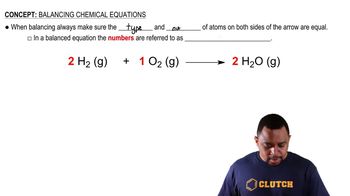
Chemical Equations

A chemical equation represents a chemical reaction using symbols and formulas. It shows the reactants on the left side and the products on the right, separated by an arrow indicating the direction of the reaction. Balancing the equation is crucial to obey the law of conservation of mass, ensuring that the number of atoms for each element is the same on both sides.
Video consigliato:
Percorso guidato
01:32
Balancing Chemical Equations

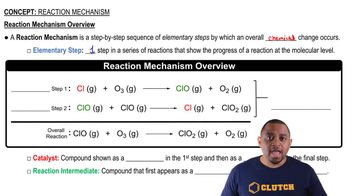
Reaction Mechanisms

A reaction mechanism describes the step-by-step sequence of elementary reactions by which overall chemical change occurs. Understanding the mechanism helps in identifying the rate-determining step, which is the slowest step that controls the speed of the overall reaction. In this case, the two-step mechanism illustrates how iodide ion facilitates the decomposition of hydrogen peroxide.
Video consigliato:
Percorso guidato
03:06
Reaction Mechanism Overview

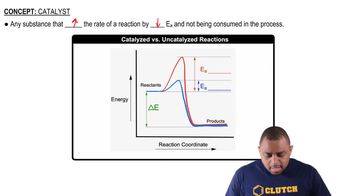
Catalysis

Catalysis involves the acceleration of a chemical reaction by a substance called a catalyst, which is not consumed in the reaction. Catalysts work by providing an alternative pathway with a lower activation energy for the reaction. In the given question, iodide ion acts as a catalyst, facilitating the breakdown of hydrogen peroxide into water and oxygen without being permanently altered.
Video consigliato:
Percorso guidato
01:59
Catalyzed vs. Uncatalyzed Reactions