
Ch.14 - Chemical Kinetics
Brown - Chemistry: The Central Science 14th Edition
Brown14th EditionChemistry: The Central ScienceISBN: 9780134414232Non è quello che usi tu?Cambia libro di testo
Capitolo 14, Problema 71

The following mechanism has been proposed for the gas-phase reaction of H2 with ICl: H2(g) + ICl(g) → HI(g) + HCl(g), HI(g) + ICl(g) → I2(g) + HCl(g). (c) If the first step is slow and the second one is fast, which rate law do you expect to be observed for the overall reaction?

Guida verificata passo dopo passo
1
Identify the elementary steps in the proposed mechanism: Step 1: H2(g) + ICl(g) → HI(g) + HCl(g) (slow), Step 2: HI(g) + ICl(g) → I2(g) + HCl(g) (fast).
Recognize that the rate-determining step is the slowest step in the mechanism, which is Step 1 in this case.
Write the rate law based on the rate-determining step. For an elementary reaction, the rate law is determined by the stoichiometry of the reactants in that step. Therefore, the rate law for Step 1 is: rate = k[H2][ICl].
Since Step 1 is the rate-determining step, the overall rate law for the reaction is the same as the rate law for Step 1.
Conclude that the observed rate law for the overall reaction is rate = k[H2][ICl], where k is the rate constant for the slow step.

Concetti chiave

Ecco i concetti essenziali che devi comprendere per rispondere correttamente alla domanda.

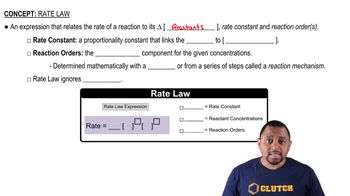
Rate Law

The rate law of a reaction expresses the relationship between the rate of a chemical reaction and the concentration of its reactants. It is typically formulated as rate = k[A]^m[B]^n, where k is the rate constant, and m and n are the orders of the reaction with respect to reactants A and B. Understanding the rate law is crucial for predicting how changes in concentration affect the reaction rate.
Video consigliato:
Percorso guidato
01:52
Rate Law Fundamentals

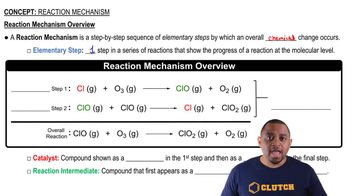
Elementary Steps

Elementary steps are the individual reactions that make up a complex reaction mechanism. Each step represents a single molecular event, and the rate of the overall reaction is determined by the slowest step, known as the rate-determining step. In this case, since the first step is slow, it will dictate the rate law for the overall reaction.
Video consigliato:
Percorso guidato
03:06
Reaction Mechanism Overview

Mechanism of Reaction

The mechanism of a reaction describes the sequence of elementary steps that lead to the overall transformation of reactants into products. It provides insight into how reactants interact at the molecular level. In the given reaction, understanding the mechanism helps in determining which step influences the rate law, particularly when one step is significantly slower than the others.
Video consigliato:
Percorso guidato
03:06
Reaction Mechanism Overview