
Ch.14 - Chemical Kinetics
Brown - Chemistry: The Central Science 14th Edition
Brown14th EditionChemistry: The Central ScienceISBN: 9780134414232Non è quello che usi tu?Cambia libro di testo
Capitolo 14, Problema 44a

The first-order rate constant for the decomposition of N2O5, 2 N2O5(g) → 4 NO2(g) + O2(g), at 70°C is 6.82×10⁻³ s-1. Suppose we start with 0.0250 mol of N2O5(g) in a volume of 2.0 L. (a) How many moles of N2O5 will remain after 5.0 min?

Guida verificata passo dopo passo
1
Identify the type of reaction and the order: The problem states that the decomposition of \( \text{N}_2\text{O}_5 \) is a first-order reaction.
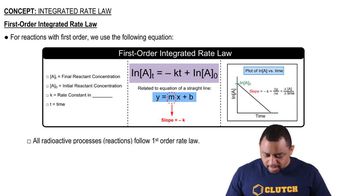
Use the first-order rate equation: \( [A]_t = [A]_0 e^{-kt} \), where \([A]_t\) is the concentration at time \(t\), \([A]_0\) is the initial concentration, \(k\) is the rate constant, and \(t\) is the time.
Calculate the initial concentration \([A]_0\): \([A]_0 = \frac{\text{moles of } \text{N}_2\text{O}_5}{\text{volume}} = \frac{0.0250 \text{ mol}}{2.0 \text{ L}}\).
Convert the time from minutes to seconds: \(5.0 \text{ min} = 5.0 \times 60 \text{ s/min} = 300 \text{ s}\).
Substitute the known values into the first-order rate equation to find \([A]_t\): \([A]_t = [A]_0 e^{-6.82 \times 10^{-3} \text{ s}^{-1} \times 300 \text{ s}}\).

Risposta video verificata per un problema simile:

Questa soluzione video è stata consigliata dai nostri tutor come utile per risolvere questo problema.

Concetti chiave

Ecco i concetti essenziali che devi comprendere per rispondere correttamente alla domanda.

First-Order Kinetics

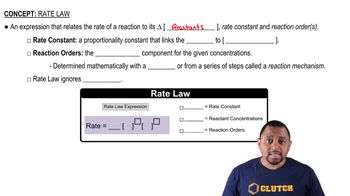
First-order kinetics refers to a reaction rate that is directly proportional to the concentration of one reactant. In this case, the decomposition of N2O5 follows first-order kinetics, meaning the rate of reaction can be expressed as rate = k[N2O5], where k is the rate constant. This relationship allows us to use the integrated rate law to calculate the concentration of N2O5 over time.
Video consigliato:
Percorso guidato
02:29
First-Order Reactions

Integrated Rate Law

The integrated rate law for a first-order reaction is given by the equation ln([A]0/[A]) = kt, where [A]0 is the initial concentration, [A] is the concentration at time t, k is the rate constant, and t is time. This equation allows us to determine the concentration of a reactant at any given time, which is essential for solving the problem of how many moles of N2O5 remain after a specified duration.
Video consigliato:
Percorso guidato
01:52
Rate Law Fundamentals

Molarity and Moles

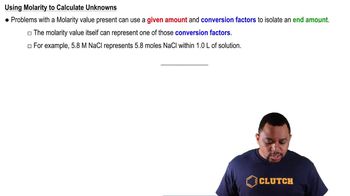
Molarity (M) is defined as the number of moles of solute per liter of solution. To find the remaining moles of N2O5 after a certain time, we first need to calculate the initial molarity using the initial moles and volume. Understanding the relationship between moles, volume, and molarity is crucial for converting between these units and applying the integrated rate law effectively.
Video consigliato: