
Ch.14 - Chemical Kinetics
Brown - Chemistry: The Central Science 14th Edition
Brown14th EditionChemistry: The Central ScienceISBN: 9780134414232Non è quello che usi tu?Cambia libro di testo
Capitolo 14, Problema 44c

The first-order rate constant for the decomposition of N2O5, 2 N2O5(g) → 4 NO2(g) + O2(g), at 70°C is 6.82×10⁻³ s-1. Suppose we start with 0.0250 mol of N2O5(g) in a volume of 2.0 L. (c) What is the half-life of N2O5 at 70°C?

Guida verificata passo dopo passo
1
Step 1: Understand that the half-life of a first-order reaction is given by the formula t1/2 = 0.693/k, where k is the rate constant.
Step 2: Identify the given rate constant (k) from the problem, which is 6.82 * 10^-3 s^-1.
Step 3: Substitute the given rate constant into the half-life formula.
Step 4: Solve the equation for t1/2 to find the half-life of N2O5 at 70 C.

Risposta video verificata per un problema simile:

Questa soluzione video è stata consigliata dai nostri tutor come utile per risolvere questo problema.
Durata del video:
1m

Concetti chiave

Ecco i concetti essenziali che devi comprendere per rispondere correttamente alla domanda.

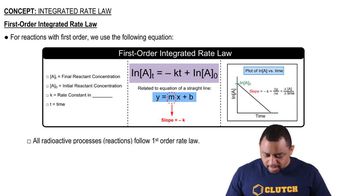
First-Order Reactions

First-order reactions are chemical reactions where the rate is directly proportional to the concentration of one reactant. In these reactions, the rate constant (k) remains constant, and the concentration of the reactant decreases exponentially over time. The half-life of a first-order reaction is independent of the initial concentration, making it a key characteristic for calculations involving such reactions.
Video consigliato:
Percorso guidato
02:29
First-Order Reactions

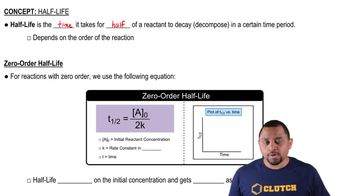
Half-Life

The half-life of a substance is the time required for half of the initial amount of that substance to undergo a reaction or decay. For first-order reactions, the half-life can be calculated using the formula t1/2 = 0.693/k, where k is the rate constant. This concept is crucial for understanding how quickly a reactant is consumed in a reaction and is particularly useful in kinetics.
Video consigliato:
Percorso guidato
02:17
Zero-Order Half-life

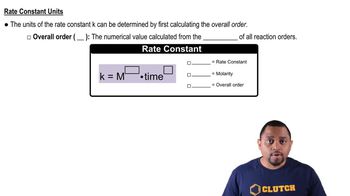
Rate Constant

The rate constant (k) is a proportionality factor in the rate equation that relates the rate of a reaction to the concentration of reactants. It is specific to a given reaction at a particular temperature and is essential for calculating reaction rates and half-lives. In the context of first-order reactions, the rate constant directly influences the duration of the half-life and the speed of the reaction.
Video consigliato:
Percorso guidato
00:45
Rate Constant Units