
Ch.14 - Chemical Kinetics
Brown - Chemistry: The Central Science 14th Edition
Brown14th EditionChemistry: The Central ScienceISBN: 9780134414232Non è quello che usi tu?Cambia libro di testo
Capitolo 14, Problema 35c

The following data were measured for the reaction BF3(g) + NH3(g) → F3BNH3(g):
Experiment [BF3] (M) [NH3] (M) Initial Rate (M/s)
1 0.250 0.250 0.2130
2 0.250 0.125 0.1065
3 0.200 0.100 0.0682
4 0.350 0.100 0.1193
5 0.175 0.100 0.0596 
(c) Calculate the rate constant with proper units?

Guida verificata passo dopo passo
1
Identify the order of the reaction from the given data or graph.
Use the appropriate rate law expression based on the order of the reaction. For example, for a first-order reaction, the rate law is: rate = k[A].
Determine the slope of the line if the graph is a plot of ln[A] vs. time for a first-order reaction or 1/[A] vs. time for a second-order reaction.
The slope of the line in a first-order reaction plot (ln[A] vs. time) is equal to -k, and in a second-order reaction plot (1/[A] vs. time), the slope is equal to k.
Calculate the rate constant (k) using the slope obtained from the graph and ensure to include the proper units for the rate constant based on the reaction order.

Risposta video verificata per un problema simile:

Questa soluzione video è stata consigliata dai nostri tutor come utile per risolvere questo problema.
Durata del video:
4m

Concetti chiave

Ecco i concetti essenziali che devi comprendere per rispondere correttamente alla domanda.

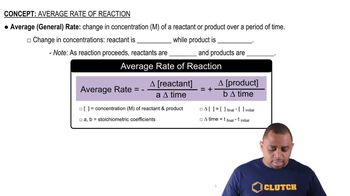
Rate of Reaction

The rate of reaction refers to the speed at which reactants are converted into products in a chemical reaction. It is typically expressed as the change in concentration of a reactant or product per unit time. Understanding the rate of reaction is crucial for calculating the rate constant, as it provides the necessary data to determine how quickly a reaction occurs under specific conditions.
Video consigliato:
Percorso guidato
02:03
Average Rate of Reaction

Rate Constant (k)

The rate constant (k) is a proportionality factor in the rate equation that relates the rate of a reaction to the concentrations of the reactants. It is specific to a particular reaction at a given temperature and is influenced by factors such as temperature and the presence of catalysts. The units of k vary depending on the order of the reaction, making it essential to understand the reaction's stoichiometry to determine the correct units.
Video consigliato:
Percorso guidato
01:14
Equilibrium Constant K

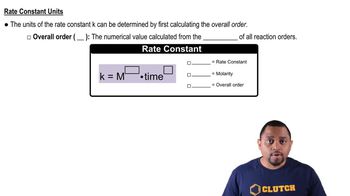
Units of Rate Constant

The units of the rate constant depend on the order of the reaction. For a first-order reaction, the unit is typically s⁻¹, while for a second-order reaction, it is M⁻¹s⁻¹. Understanding how to derive these units from the rate equation is vital for correctly calculating and reporting the rate constant, ensuring that the results are meaningful and applicable in chemical kinetics.
Video consigliato:
Percorso guidato
00:45
Rate Constant Units