Ch.14 - Chemical Kinetics
Brown - Chemistry: The Central Science 14th Edition
Brown14th EditionChemistry: The Central ScienceISBN: 9780134414232Non è quello che usi tu?Cambia libro di testo
Capitolo 14, Problema 107a

The following mechanism has been proposed for the reaction of NO with H2 to form N2O and H2O:
NO(g) + NO(g) → N2O2(g)
N2O2(g) + H2(g) → N2O(g) + H2O(g)
(a) Show that the elementary reactions of the proposed mechanism add to provide a balanced equation for the reaction.

Guida verificata passo dopo passo
1
Step 1: Write down the two elementary reactions given in the mechanism. The first reaction is: NO(g) + NO(g) → N2O2(g). The second reaction is: N2O2(g) + H2(g) → N2O(g) + H2O(g).
Step 2: Add the reactants from both elementary reactions together. This gives: NO(g) + NO(g) + N2O2(g) + H2(g).
Step 3: Add the products from both elementary reactions together. This gives: N2O2(g) + N2O(g) + H2O(g).
Step 4: Cancel out any species that appear on both sides of the equation. In this case, N2O2(g) appears as both a reactant and a product, so it can be canceled out.
Step 5: Write the final balanced equation after canceling out common species. The balanced equation is: 2NO(g) + H2(g) → N2O(g) + H2O(g). This shows that the elementary reactions add up to provide the balanced equation for the overall reaction.

Risposta video verificata per un problema simile:

Questa soluzione video è stata consigliata dai nostri tutor come utile per risolvere questo problema.
Durata del video:
2m

Concetti chiave

Ecco i concetti essenziali che devi comprendere per rispondere correttamente alla domanda.

Elementary Reactions

Elementary reactions are the simplest types of chemical reactions that occur in a single step, involving a direct interaction between reactants to form products. Each elementary reaction has its own rate law, which can be derived from its molecularity, indicating how many molecules are involved in the reaction. Understanding these reactions is crucial for analyzing reaction mechanisms and determining the overall stoichiometry of a chemical process.
Video consigliato:
Percorso guidato
03:06
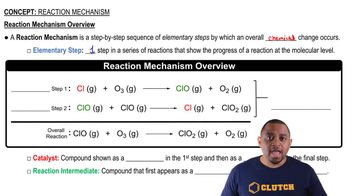
Reaction Mechanism Overview

Balancing Chemical Equations

Balancing chemical equations involves ensuring that the number of atoms of each element is the same on both the reactant and product sides of the equation. This is based on the law of conservation of mass, which states that matter cannot be created or destroyed in a chemical reaction. A balanced equation provides a clear representation of the reactants and products, allowing for accurate stoichiometric calculations.
Video consigliato:
Percorso guidato
01:32
Balancing Chemical Equations

Reaction Mechanisms

A reaction mechanism is a detailed description of the step-by-step process by which reactants are converted into products. It includes all elementary reactions involved, their sequence, and the intermediates formed during the reaction. Understanding the mechanism is essential for predicting the rate of reaction and the conditions under which the reaction occurs, as well as for deriving the overall balanced equation from the individual steps.
Video consigliato:
Percorso guidato
03:06
Reaction Mechanism Overview