Ch.14 - Chemical Kinetics
Brown - Chemistry: The Central Science 14th Edition
Brown14th EditionChemistry: The Central ScienceISBN: 9780134414232Non è quello che usi tu?Cambia libro di testo
Capitolo 14, Problema 109a

The gas-phase decomposition of ozone is thought to occur by the following two-step mechanism.
Step 1: O3(g) ⇌ O2(g) + O(g) (fast)
Step 2: O(g) + O3(g) → 2 O2 (slow)
(a) Write the balanced equation for the overall reaction.

Guida verificata passo dopo passo
1
Identify the reactants and products in each step of the mechanism. In Step 1, ozone (O3) decomposes into oxygen (O2) and an oxygen atom (O). In Step 2, the oxygen atom (O) reacts with another ozone molecule (O3) to form two oxygen molecules (2 O2).
Add the two steps together to find the overall reaction. This involves summing up all reactants and products from both steps.
Cancel out any intermediates that appear on both sides of the reaction. In this case, the oxygen atom (O) is an intermediate that appears as a product in Step 1 and a reactant in Step 2, so it cancels out.
Combine the remaining reactants and products to write the balanced equation for the overall reaction. After canceling the intermediate, you should have the reactants and products that represent the overall process.
Verify that the equation is balanced by ensuring that the number of each type of atom is the same on both sides of the equation. This confirms that the overall reaction is correctly represented.

Risposta video verificata per un problema simile:

Questa soluzione video è stata consigliata dai nostri tutor come utile per risolvere questo problema.
Durata del video:
1m

Concetti chiave

Ecco i concetti essenziali che devi comprendere per rispondere correttamente alla domanda.

Balanced Chemical Equation

A balanced chemical equation represents a chemical reaction with equal numbers of each type of atom on both sides of the equation. This ensures the law of conservation of mass is upheld, meaning that matter is neither created nor destroyed in a chemical reaction. Balancing involves adjusting coefficients in front of the chemical formulas to achieve this equality.
Video consigliato:
Percorso guidato
01:32
Balancing Chemical Equations

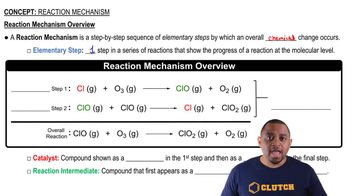
Reaction Mechanism

A reaction mechanism is a detailed description of the steps involved in a chemical reaction, including the sequence of elementary reactions. Each step can vary in speed, with some being fast and others slow, which affects the overall rate of the reaction. Understanding the mechanism helps in predicting the products and the rate of the reaction.
Video consigliato:
Percorso guidato
03:06
Reaction Mechanism Overview

Elementary Reactions

Elementary reactions are single-step processes that describe the direct transformation of reactants into products. Each elementary reaction has its own rate law, which can be determined experimentally. In the given mechanism, the first step is fast and reversible, while the second step is slow and irreversible, influencing the overall reaction dynamics.
Video consigliato:
Percorso guidato
03:06
Reaction Mechanism Overview
Pratica correlata
Domanda del libro di testo

Ozone in the upper atmosphere can be destroyed by the following two-step mechanism:

Cl(g) + O3(g) → ClO(g) + O2(g)

ClO(g) + O(g) → Cl(g) + O2(g) 

(b) What is the catalyst in the reaction?

621
views

Domanda del libro di testo

Ozone in the upper atmosphere can be destroyed by the following two-step mechanism:

Cl(g) + O3(g) → ClO(g) + O2(g)

ClO(g) + O(g) → Cl(g) + O2(g)

(a) What is the overall equation for this process?

Domanda del libro di testo

The gas-phase decomposition of ozone is thought to occur by the following two-step mechanism.

Step 1: O3(g) ⇌ O2(g) + O(g) (fast)

Step 2: O(g) + O3(g) → 2 O2 (slow)

(b) Derive the rate law that is consistent with this mechanism. (Hint: The product appears in the rate law.)

867
views
Domanda del libro di testo

The following mechanism has been proposed for the reaction of NO with H2 to form N2O and H2O:

NO(g) + NO(g) → N2O2(g)

N2O2(g) + H2(g) → N2O(g) + H2O(g)

(d) The observed rate law is rate = k[NO]2[H2]. If the proposed mechanism is correct, what can we conclude about the relative speeds of the first and second reactions?

1616
views
Domanda del libro di testo
The following mechanism has been proposed for the gasphase reaction of chloroform 1CHCl32 and chlorine: Step 1: Cl21g2 Δ k1 k - 1 2 Cl1g2 1fast2 Step 2: Cl1g2 + CHCl31g2 ¡k2 HCl1g2 + CCl31g2 1slow2 Step 3: Cl1g2 + CCl31g2 ¡k3 CCl4 1fast2 (a) What is the overall reaction?
575
views
Domanda del libro di testo

The gas-phase decomposition of ozone is thought to occur by the following two-step mechanism.

Step 1: O3(g) ⇌ O2(g) + O(g) (fast)

Step 2: O(g) + O3(g) → 2 O2 (slow)

(d) If instead the reaction occurred in a single step, would the rate law change? If so, what would it be?

1055
views