Ch.14 - Chemical Kinetics
Brown - Chemistry: The Central Science 14th Edition
Brown14th EditionChemistry: The Central ScienceISBN: 9780134414232Non è quello che usi tu?Cambia libro di testo
Capitolo 14, Problema 121a

The mechanism for the oxidation of HBr by O2 to form 2 H2O and Br2 is shown in Exercise 14.74. (a) Calculate the overall standard enthalpy change for the reaction process.

Guida verificata passo dopo passo
1
Identify the balanced chemical equation for the reaction: \(4 \text{HBr} + \text{O}_2 \rightarrow 2 \text{H}_2\text{O} + 2 \text{Br}_2\).
Determine the standard enthalpy of formation (\(\Delta H_f^\circ\)) for each reactant and product from a reliable source, such as a chemistry textbook or database.
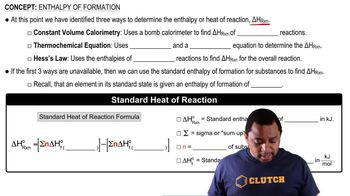
Use the formula for the standard enthalpy change of the reaction: \(\Delta H_{reaction}^\circ = \sum \Delta H_f^\circ (\text{products}) - \sum \Delta H_f^\circ (\text{reactants})\).
Calculate the sum of the standard enthalpies of formation for the products: \(2 \times \Delta H_f^\circ (\text{H}_2\text{O}) + 2 \times \Delta H_f^\circ (\text{Br}_2)\).
Calculate the sum of the standard enthalpies of formation for the reactants: \(4 \times \Delta H_f^\circ (\text{HBr}) + 1 \times \Delta H_f^\circ (\text{O}_2)\), and then subtract the reactants' sum from the products' sum to find the overall \(\Delta H_{reaction}^\circ\).

Risposta video verificata per un problema simile:

Questa soluzione video è stata consigliata dai nostri tutor come utile per risolvere questo problema.
Durata del video:
4m

Concetti chiave

Ecco i concetti essenziali che devi comprendere per rispondere correttamente alla domanda.

Standard Enthalpy Change

Standard enthalpy change (ΔH°) refers to the heat change that occurs at constant pressure when reactants are converted to products under standard conditions (1 atm pressure and a specified temperature, usually 25°C). It is a crucial concept in thermodynamics, allowing chemists to predict the energy changes associated with chemical reactions.
Video consigliato:
Percorso guidato
02:34
Enthalpy of Formation

Hess's Law

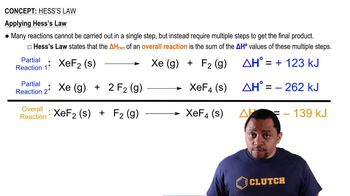
Hess's Law states that the total enthalpy change for a reaction is the sum of the enthalpy changes for the individual steps of the reaction, regardless of the pathway taken. This principle allows for the calculation of enthalpy changes for complex reactions by breaking them down into simpler steps for which enthalpy values are known.
Video consigliato:

Bond Enthalpies

Bond enthalpy is the energy required to break one mole of a specific type of bond in a gaseous molecule. Understanding bond enthalpies is essential for calculating the overall enthalpy change of a reaction, as it involves summing the energies required to break bonds in the reactants and the energies released when forming bonds in the products.
Video consigliato:
Percorso guidato
02:34
Enthalpy of Formation
Pratica correlata
Domanda del libro di testo

The reaction between ethyl iodide and hydroxide ion in ethanol (C2H5OH) solution, C2H5I(alc) + OH-(alc) → C2H5OH(l) + I-(alc), has an activation energy of 86.8 kJ/mol and a frequency factor of 2.10 × 10¹¹ M-1 s-1. (d) Assuming the frequency factor and activation energy do not change as a function of temperature, calculate the rate constant for the reaction at 50 C.

532
views
Domanda del libro di testo

The rates of many atmospheric reactions are accelerated by the absorption of light by one of the reactants. For example, consider the reaction between methane and chlorine to produce methyl chloride and hydrogen chloride:

Reaction 1: CH4(g) + Cl2(g) → CH3Cl(g) + HCl(g)

This reaction is very slow in the absence of light. However, Cl2(g) can absorb light to form Cl atoms:

Reaction 2: Cl2(g) + hv → 2 Cl(g)

Once the Cl atoms are generated, they can catalyze the reaction of CH4 and Cl2, according to the following proposed mechanism:

Reaction 3: CH4(g) + Cl(g) → CH3(g) + HCl(g)

Reaction 4: CH3(g) + Cl2(g) → CH3Cl(g) + Cl(g)

The enthalpy changes and activation energies for these two reactions are tabulated as follows:

Reaction ΔH° (kJ/mol) Ea (kJ/mol)

3 +4 17

4 -109 4 

(b) By using the data tabulated here, sketch a quantitative energy profile for the catalyzed reaction represented by reactions 3 and 4.

424
views
Domanda del libro di testo

The gas-phase reaction of NO with F2 to form NOF and F has an activation energy of Ea = 6.3 kJ>mol. and a frequency factor of A = 6.0 * 108 M-1 s-1. The reaction is believed to be bimolecular: NO1g2 + F21g2 ¡ NOF1g2 + F1g2 (e) Suggest a reason for the low activation energy for the reaction.

793
views
Domanda del libro di testo

The gas-phase reaction of NO with F2 to form NOF and F has an activation energy of Ea = 6.3 kJ/mol. and a frequency factor of A = 6.0 × 10⁸ M-1 s-1. The reaction is believed to be bimolecular: NO(g) + F2(g) → NOF(g) + F(g) (b) Draw the Lewis structures for the NO and the NOF molecules, given that the chemical formula for NOF is misleading because the nitrogen atom is actually the central atom in the molecule.

Domanda del libro di testo

The mechanism for the oxidation of HBr by O2 to form 2 H2O and Br2 is shown in Exercise 14.74. (c) Draw a plausible Lewis structure for the intermediate HOOBr. To what familiar compound of hydrogen and oxygen does it appear similar?

631
views