
Ch.15 - Chemical Equilibrium
Brown - Chemistry: The Central Science 14th Edition
Brown14th EditionChemistry: The Central ScienceISBN: 9780134414232Non è quello che usi tu?Cambia libro di testo
Capitolo 15, Problema 54

At 218°C, 𝐾𝑐 = 1.2×10⁻⁴ for the equilibrium NH4SH(𝑠) ⇌ NH3(𝑔) + H2S(𝑔) Calculate the equilibrium concentrations of NH3 and H2S if a sample of solid NH4SH is placed in a closed vessel at 218°C and decomposes until equilibrium is reached.

Guida verificata passo dopo passo
1
Write the equilibrium expression for the reaction: For the decomposition of ammonium hydrosulfide, the equilibrium constant expression (Kc) is given by Kc = [NH3][H2S], where [NH3] and [H2S] are the molar concentrations of ammonia and hydrogen sulfide, respectively.
Set up the expression using initial concentrations and changes at equilibrium: Assume the initial concentrations of NH3 and H2S are 0 M. Let x be the change in concentration of NH3 and H2S at equilibrium. Since the stoichiometry of NH3 and H2S in the balanced equation is 1:1, the concentration of each at equilibrium will be x M.
Substitute the equilibrium concentrations into the Kc expression: Substitute x for [NH3] and [H2S] in the equilibrium expression, resulting in Kc = x^2.
Solve for x: Rearrange the equation to solve for x. Since Kc = 1.2×10^(-4), set up the equation x^2 = 1.2×10^(-4). Solve for x to find the equilibrium concentrations of NH3 and H2S.
Check the units and make sure they are consistent throughout the problem to ensure the correctness of the calculation.

Risposta video verificata per un problema simile:

Questa soluzione video è stata consigliata dai nostri tutor come utile per risolvere questo problema.
Durata del video:
2m

Concetti chiave

Ecco i concetti essenziali che devi comprendere per rispondere correttamente alla domanda.

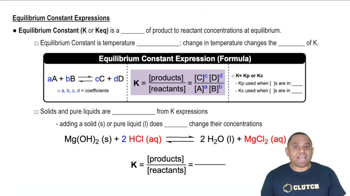
Equilibrium Constant (Kc)

The equilibrium constant (Kc) is a numerical value that expresses the ratio of the concentrations of products to reactants at equilibrium for a given reaction at a specific temperature. For the reaction NH₄SH(s) ⇌ NH₃(g) + H₂S(g), Kc = [NH₃][H₂S] / [NH₄SH]. Since NH₄SH is a solid, its concentration does not appear in the expression, simplifying the calculation of equilibrium concentrations.
Video consigliato:
Percorso guidato
03:20
Equilibrium Constant Expressions

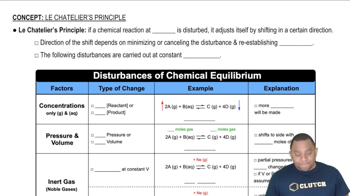
Le Chatelier's Principle

Le Chatelier's Principle states that if a system at equilibrium is disturbed by changing the conditions (such as concentration, temperature, or pressure), the system will adjust to counteract the disturbance and restore a new equilibrium. In this case, the decomposition of solid NH₄SH into gaseous products will shift the equilibrium position to favor the formation of NH₃ and H₂S until the equilibrium concentrations are established.
Video consigliato:
Percorso guidato
07:32
Le Chatelier's Principle

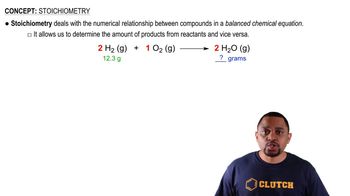
Stoichiometry of the Reaction

Stoichiometry involves the quantitative relationships between the reactants and products in a chemical reaction. For the decomposition of NH₄SH, the stoichiometry indicates that one mole of NH₄SH produces one mole of NH₃ and one mole of H₂S. This relationship is crucial for calculating the equilibrium concentrations of the gaseous products based on the initial amount of solid NH₄SH and the value of Kc.
Video consigliato:
Percorso guidato
01:16
Stoichiometry Concept
Pratica correlata