Ch.15 - Chemical Equilibrium
Brown - Chemistry: The Central Science 14th Edition
Brown14th EditionChemistry: The Central ScienceISBN: 9780134414232Non è quello che usi tu?Cambia libro di testo
Capitolo 15, Problema 52

For the equilibrium Br2(𝑔) + Cl2(𝑔) ⇌ 2 BrCl(𝑔) at 400 K, 𝐾𝑐 = 7.0. If 0.25 mol of Br2 and 0.55 mol of Cl2 are introduced into a 3.0-L container at 400 K, what will be the equilibrium concentrations of Br2, Cl2, and BrCl?

Guida verificata passo dopo passo
1
Identify the initial concentrations of Br_2 and Cl_2 by dividing the moles by the volume of the container: [Br_2]_0 = \(\frac{0.25 \text{ mol}\)}{3.0 \(\text{ L}\)}, [Cl_2]_0 = \(\frac{0.55 \text{ mol}\)}{3.0 \(\text{ L}\)}.
Set up an ICE (Initial, Change, Equilibrium) table to track the changes in concentrations as the system reaches equilibrium. Let x be the change in concentration of Br_2 and Cl_2 that reacts to form BrCl.
Write the expression for the equilibrium constant K_c: K_c = \(\frac{[BrCl]^2}{[Br_2][Cl_2]}\).
Substitute the equilibrium concentrations from the ICE table into the K_c expression: K_c = \(\frac{(2x)^2}{([Br_2]_0 - x)([Cl_2]_0 - x)}\).
Solve the equation for x, which represents the change in concentration, and use it to find the equilibrium concentrations: [Br_2] = [Br_2]_0 - x, [Cl_2] = [Cl_2]_0 - x, [BrCl] = 2x.

Risposta video verificata per un problema simile:

Questa soluzione video è stata consigliata dai nostri tutor come utile per risolvere questo problema.
Durata del video:
10m

Concetti chiave

Ecco i concetti essenziali che devi comprendere per rispondere correttamente alla domanda.

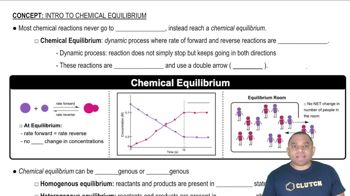
Chemical Equilibrium

Chemical equilibrium occurs when the rates of the forward and reverse reactions are equal, resulting in constant concentrations of reactants and products. In this state, the system is dynamic, meaning that reactions continue to occur, but there is no net change in concentration. Understanding this concept is crucial for analyzing how concentrations shift in response to changes in conditions, such as concentration or temperature.
Video consigliato:
Percorso guidato
04:21
Chemical Equilibrium Concepts

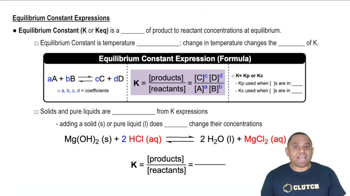
Equilibrium Constant (Kc)

The equilibrium constant (Kc) is a numerical value that expresses the ratio of the concentrations of products to reactants at equilibrium, each raised to the power of their coefficients in the balanced equation. For the reaction Br<sub>2</sub>(g) + Cl<sub>2</sub>(g) ⇌ 2 BrCl(g), Kc = [BrCl]<sup>2</sup> / ([Br<sub>2</sub>][Cl<sub>2</sub>]). This constant provides insight into the extent of the reaction and helps predict the direction in which the reaction will shift to reach equilibrium.
Video consigliato:
Percorso guidato
03:20
Equilibrium Constant Expressions

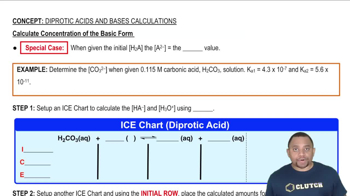
Concentration Calculations

Concentration calculations involve determining the molarity of substances in a solution, which is defined as the number of moles of solute divided by the volume of the solution in liters. In this problem, the initial concentrations of Br<sub>2</sub> and Cl<sub>2</sub> must be calculated based on the given moles and the volume of the container. These initial concentrations are essential for applying the equilibrium expression and finding the equilibrium concentrations of all species involved.
Video consigliato:
Percorso guidato
07:35
Calculate Concentration of the Basic Form