Consider the reaction 4 NH3(𝑔) + 5 O2(𝑔) ⇌ 4 NO(𝑔) + 6 H2O(𝑔), Δ𝐻 = −904.4 kJ Does each of the following increase, decrease, or leave unchanged the yield of NO at equilibrium? (e) add a catalyst
Ch.15 - Chemical Equilibrium
Brown14th EditionChemistry: The Central ScienceISBN: 9780134414232Non è quello che usi tu?Cambia libro di testo
Capitolo 15, Problema 62f
Consider the reaction 4 NH3(𝑔) + 5 O2(𝑔) ⇌ 4 NO(𝑔) + 6 H2O(𝑔), Δ𝐻 = −904.4 kJ Does each of the following increase, decrease, or leave unchanged the yield of NO at equilibrium? (f) increase temperature.
Guida verificata passo dopo passo1
Identify the type of reaction: The given reaction is exothermic, as indicated by the negative \( \Delta H = -904.4 \) kJ.
Apply Le Chatelier's Principle: In an exothermic reaction, increasing the temperature will shift the equilibrium position to favor the endothermic direction, which is the reverse reaction in this case.
Determine the effect on NO yield: Since the equilibrium shifts towards the reactants (reverse reaction), the yield of NO will decrease.
Consider the overall impact: Increasing temperature in an exothermic reaction generally decreases the yield of products formed in the forward reaction.
Conclude: Therefore, increasing the temperature will decrease the yield of NO at equilibrium.

Risposta video verificata per un problema simile:
Questa soluzione video è stata consigliata dai nostri tutor come utile per risolvere questo problema.
Durata del video:
3mConcetti chiave
Ecco i concetti essenziali che devi comprendere per rispondere correttamente alla domanda.
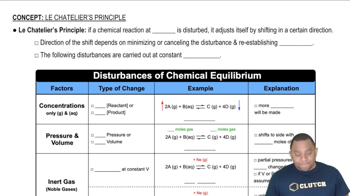
Le Chatelier's Principle
Le Chatelier's Principle states that if a dynamic equilibrium is disturbed by changing the conditions, the position of equilibrium shifts to counteract the change. In the context of temperature changes, if the reaction is exothermic (releases heat), increasing the temperature will shift the equilibrium to favor the reactants, thereby decreasing the yield of products.
Video consigliato:
Percorso guidato
Le Chatelier's Principle
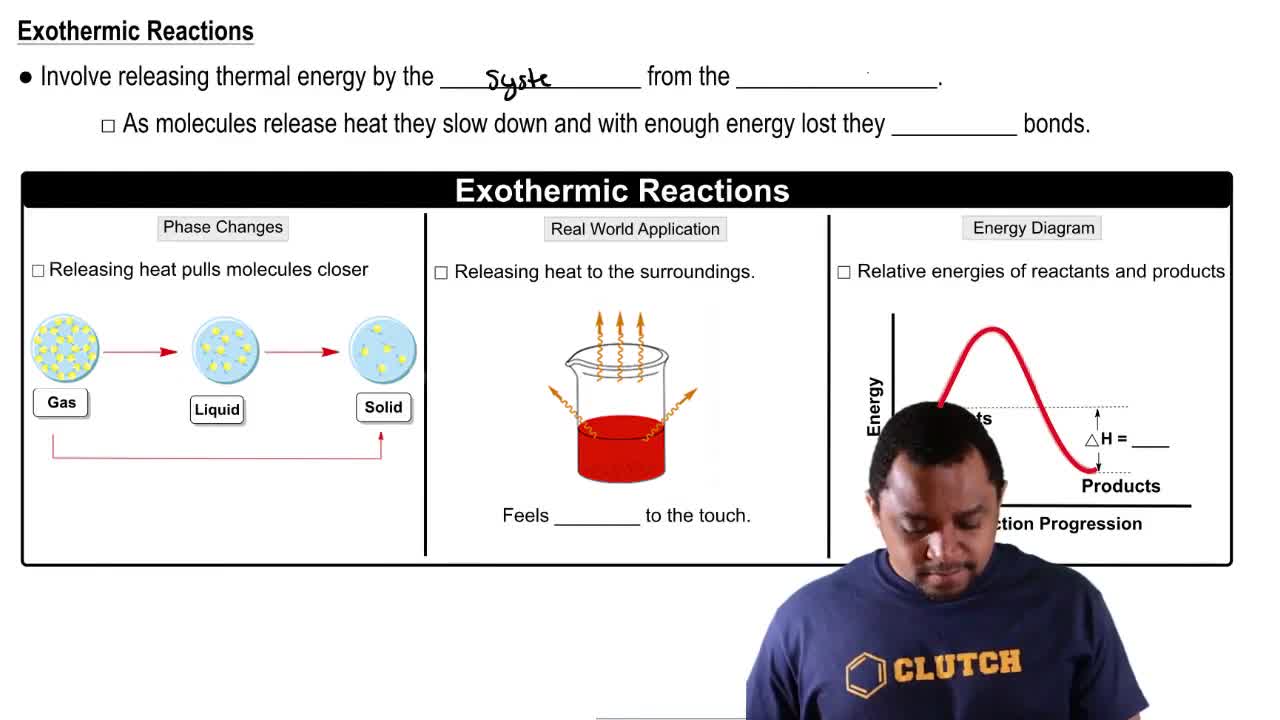
Exothermic Reactions
An exothermic reaction is one that releases energy in the form of heat. In the given reaction, the negative ΔH value indicates that it is exothermic. When the temperature is increased, the system will respond by favoring the endothermic direction (the reverse reaction) to absorb the added heat, which reduces the production of NO.
Video consigliato:
Percorso guidato
Endothermic & Exothermic Reactions
Equilibrium Constant (K)
The equilibrium constant (K) quantifies the ratio of the concentrations of products to reactants at equilibrium for a given reaction at a specific temperature. Changes in temperature can alter the value of K, affecting the position of equilibrium. For exothermic reactions, increasing temperature decreases K, leading to a lower concentration of products like NO at equilibrium.
Video consigliato:
Percorso guidato
Equilibrium Constant K
Pratica correlata
Domanda del libro di testo
304
views
Domanda del libro di testo
Consider the following equilibrium between oxides of nitrogen 3 NO(g) ⇌ NO2(g) + N2O(g) (a) Use data in Appendix C to calculate ΔH° for this reaction.
470
views
Domanda del libro di testo
Consider the reaction 4 NH3(𝑔) + 5 O2(𝑔) ⇌ 4 NO(𝑔) + 6 H2O(𝑔), Δ𝐻 = −904.4 kJ Does each of the following increase, decrease, or leave unchanged the yield of NO at equilibrium? (d) decrease the volume of the container in which the reaction occurs
487
views
Domanda del libro di testo
Consider the reaction 4 NH3(𝑔) + 5 O2(𝑔) ⇌ 4 NO(𝑔) + 6 H2O(𝑔), Δ𝐻 = −904.4 kJ Does each of the following increase, decrease, or leave unchanged the yield of NO at equilibrium? (a) increase [NH3] (b) increase [H2O] (c) decrease [O2]
296
views