Methanol (CH3OH) can be made by the reaction of CO with H2: CO(𝑔) + 2 H2(𝑔) ⇌ CH3OH(𝑔) (b) To maximize the equilibrium yield of methanol, would you use a high or low temperature?
Ch.15 - Chemical Equilibrium
Brown14th EditionChemistry: The Central ScienceISBN: 9780134414232Non è quello che usi tu?Cambia libro di testo
Capitolo 15, Problema 65a
Consider the following equilibrium between oxides of nitrogen 3 NO(g) ⇌ NO2(g) + N2O(g) (a) Use data in Appendix C to calculate ΔH° for this reaction.
Guida verificata passo dopo passo1
Identify the standard enthalpies of formation (ΔH°f) for each compound involved in the reaction from Appendix C. You will need the values for NO(g), NO2(g), and N2O(g).
Write the balanced chemical equation for the reaction: 3 NO(g) ⇌ NO2(g) + N2O(g).
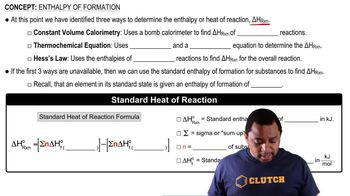
Apply the formula for the standard enthalpy change of the reaction (ΔH°rxn): ΔH°rxn = ΣΔH°f(products) - ΣΔH°f(reactants). Remember to multiply the ΔH°f of each substance by its stoichiometric coefficient in the balanced equation.
Calculate the sum of the standard enthalpies of formation for the products: (1 mole of NO2(g) × ΔH°f of NO2(g)) + (1 mole of N2O(g) × ΔH°f of N2O(g)).
Calculate the sum of the standard enthalpies of formation for the reactants: 3 moles of NO(g) × ΔH°f of NO(g).

Risposta video verificata per un problema simile:
Questa soluzione video è stata consigliata dai nostri tutor come utile per risolvere questo problema.
Durata del video:
3mConcetti chiave
Ecco i concetti essenziali che devi comprendere per rispondere correttamente alla domanda.
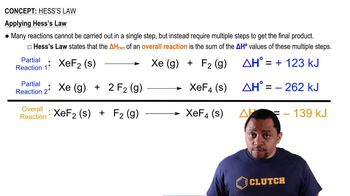
Hess's Law
Hess's Law states that the total enthalpy change for a chemical reaction is the sum of the enthalpy changes for the individual steps of the reaction, regardless of the pathway taken. This principle allows for the calculation of ΔH° for reactions that may not be easily measured directly by using known enthalpy changes of related reactions.
Video consigliato:
Percorso guidato
Hess's Law
Standard Enthalpy of Formation (ΔH°f)
The standard enthalpy of formation (ΔH°f) is the change in enthalpy when one mole of a compound is formed from its elements in their standard states. This value is crucial for calculating the enthalpy change of a reaction using Hess's Law, as it provides a reference point for the energy content of reactants and products.
Video consigliato:
Percorso guidato
Enthalpy of Formation
Equilibrium Constant (K)
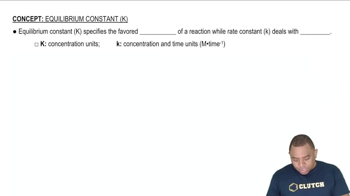
The equilibrium constant (K) is a numerical value that expresses the ratio of the concentrations of products to reactants at equilibrium for a given reaction at a specific temperature. Understanding K is essential for analyzing the position of equilibrium and how changes in conditions can affect the reaction, which is relevant when considering the enthalpy changes in reactions involving gases.
Video consigliato:
Percorso guidato
Equilibrium Constant K
Pratica correlata
Domanda del libro di testo
583
views
Domanda del libro di testo
Methanol (CH3OH) can be made by the reaction of CO with H2: CO(𝑔) + 2 H2(𝑔) ⇌ CH3OH(𝑔) (a) Use thermochemical data in Appendix C to calculate ΔH° for this reaction.
1098
views
Domanda del libro di testo
Consider the reaction 4 NH3(𝑔) + 5 O2(𝑔) ⇌ 4 NO(𝑔) + 6 H2O(𝑔), Δ𝐻 = −904.4 kJ Does each of the following increase, decrease, or leave unchanged the yield of NO at equilibrium? (f) increase temperature.
409
views
Domanda del libro di testo
Consider the following equilibrium between oxides of nitrogen
3 NO(g) ⇌ NO2(g) + N2O(g)
(c) At constant temperature, would a change in the volume of the container affect the fraction of products in the equilibrium mixture?