Ch.15 - Chemical Equilibrium
Brown - Chemistry: The Central Science 14th Edition
Brown14th EditionChemistry: The Central ScienceISBN: 9780134414232Non è quello che usi tu?Cambia libro di testo
Capitolo 15, Problema 17

When the following reactions come to equilibrium, does the equilibrium mixture contain mostly reactants or mostly products? (a) N2(g) + O2(g) ⇌ 2 NO(g), Kc = 1.5 × 10^-10 (b) 2 SO2(g) + O2(g) ⇌ 2 SO3(g), Kp = 2.5 × 10^9

Guida verificata passo dopo passo
1
Step 1: Understand the concept of equilibrium constant (K). The equilibrium constant (K) is a measure of the extent of a reaction at equilibrium. A large K value (K >> 1) indicates that the reaction favors the formation of products, while a small K value (K << 1) indicates that the reaction favors the formation of reactants.
Step 2: Analyze reaction (a) N2(g) + O2(g) ⇌ 2 NO(g) with Kc = 1.5 × 10^-10. Since Kc is much less than 1, this suggests that at equilibrium, the concentration of reactants (N2 and O2) is much greater than the concentration of products (NO).
Step 3: Conclude for reaction (a) that the equilibrium mixture contains mostly reactants because the equilibrium constant is very small, indicating the reaction does not proceed far towards products.
Step 4: Analyze reaction (b) 2 SO2(g) + O2(g) ⇌ 2 SO3(g) with Kp = 2.5 × 10^9. Since Kp is much greater than 1, this suggests that at equilibrium, the concentration of products (SO3) is much greater than the concentration of reactants (SO2 and O2).
Step 5: Conclude for reaction (b) that the equilibrium mixture contains mostly products because the equilibrium constant is very large, indicating the reaction proceeds significantly towards products.

Concetti chiave

Ecco i concetti essenziali che devi comprendere per rispondere correttamente alla domanda.

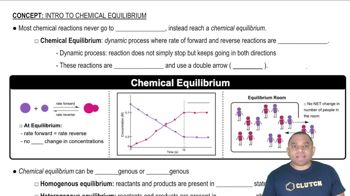
Chemical Equilibrium

Chemical equilibrium occurs when the rates of the forward and reverse reactions are equal, resulting in constant concentrations of reactants and products. At this point, the system is dynamic, meaning that reactions continue to occur, but there is no net change in the concentrations of the substances involved.
Video consigliato:
Percorso guidato
04:21
Chemical Equilibrium Concepts

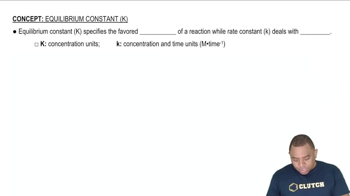
Equilibrium Constant (K)

The equilibrium constant (K) quantifies the ratio of the concentrations of products to reactants at equilibrium for a given reaction at a specific temperature. A large K value (much greater than 1) indicates that products are favored at equilibrium, while a small K value (much less than 1) suggests that reactants are favored.
Video consigliato:
Percorso guidato
01:14
Equilibrium Constant K

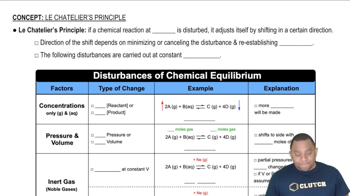
Le Chatelier's Principle

Le Chatelier's Principle states that if a system at equilibrium is disturbed by changes in concentration, temperature, or pressure, the system will adjust to counteract the disturbance and restore a new equilibrium. This principle helps predict how changes will affect the position of equilibrium in a reaction.
Video consigliato:
Percorso guidato
07:32
Le Chatelier's Principle