
The equilibrium constant for the dissociation of molecular iodine, I2(g) ⇌ 2 I(g), at 800 K is Kc = 3.1×10⁻⁵. (b) Assuming both forward and reverse reactions are elementary reactions, which reaction has the larger rate constant, the forward or the reverse reaction?
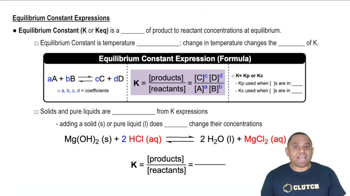
Write the expressions for 𝐾𝑐 for the following reactions. In each case indicate whether the reaction is homogeneous or heterogeneous.
(b) Ti(𝑠) + 2Cl2(𝑔) ⇌ TiCl4(𝑙)
Guida verificata passo dopo passo
Risposta video verificata per un problema simile:
Concetti chiave
Equilibrium Constant (Kc)
Homogeneous vs. Heterogeneous Reactions
Phase Representation in Kc Expressions
Write the expressions for Kc for the following reactions. In each case indicate whether the reaction is homogeneous or heterogeneous.
(a) 2 O3(g) ⇌ 3 O2(g)
(c) 2 C2H4(g) + 2 H2O(g) ⇌ 2 C2H6(g) + O2(g)
(d) C(s) + 2 H2(g) ⇌ CH4(g)
(e) 4 HCl(aq) + O2(g) ⇌ 2 H2O(l) + 2 Cl2(g)
(f) 2 C8H18(l) + 25 O2(g) ⇌ 16 CO2(g) + 18 H2O(g)
(g) 2 C8H18(l) + 25 O2(g) ⇌ 16 CO2(g) + 18 H2O(l)
Write the expression for Kc for the following reactions. In each case indicate whether the reaction is homogeneous or heterogeneous.
(a) 3 NO(g) ⇌ N2O(g) + NO2(g)
(b) CH4(g) + 2 H2S(g) ⇌ CS2(g) + 4 H2(g)
(c) Ni(CO)4(g) ⇌ Ni(s) + 4 CO(g)
(d) HF(aq) ⇌ H+(aq) + F-(aq)
(e) 2Ag(s) + Zn2+(aq) ⇌ 2 Ag+(aq) + Zn(s)
(f) H2O(l) ⇌ H+(aq) + OH-(aq)
(g) 2 H2O(l) ⇌ 2 H+(aq) + 2 OH-(aq)
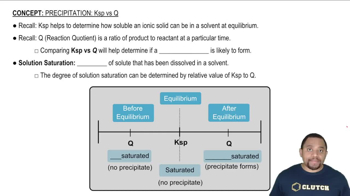
Which of the following reactions lies to the right, favoring the formation of products, and which lies to the left, favoring the formation of reactants?
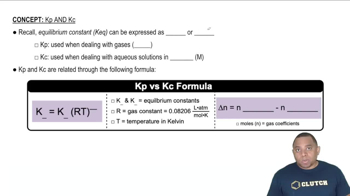
(a) 2 NO(g) + O2(g) ⇌ 2 NO2(g) Kp = 5.0 × 10¹²
(b) 2 HBr(g) ⇌ H2(g) + Br2(g) Kc = 5.8×10⁻¹⁸
