Calculate [OH-] and pH for each of the following strong base solutions: (c) 10.0 mL of 0.0105 M Ca(OH)2 diluted to 500.0 mL
Guida verificata passo dopo passo
1
Step 1: Identify the base in the solution. In this case, the base is Ca(OH)2. It's a strong base, which means it will dissociate completely in water to form Ca2+ and 2OH- ions.
Step 2: Calculate the initial concentration of OH- ions. Since each Ca(OH)2 molecule produces 2 OH- ions, the initial concentration of OH- ions is twice the concentration of Ca(OH)2. In this case, the initial concentration of OH- ions is 2 * 0.0105 M = 0.021 M.
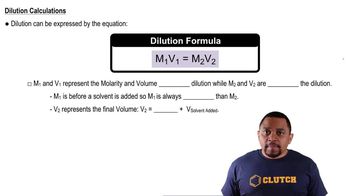
Step 3: Calculate the final concentration of OH- ions after dilution. The formula for dilution is M1V1 = M2V2, where M1 and V1 are the initial molarity and volume, and M2 and V2 are the final molarity and volume. In this case, M1 = 0.021 M, V1 = 10.0 mL, and V2 = 500.0 mL. Solve for M2 to find the final concentration of OH- ions.
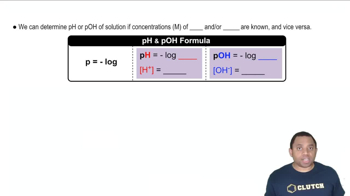
Step 4: Calculate pOH using the formula pOH = -log[OH-]. Use the final concentration of OH- ions from step 3.
Step 5: Calculate pH using the formula pH = 14 - pOH. Use the pOH value from step 4.
Risposta video verificata per un problema simile:
Questa soluzione video è stata consigliata dai nostri tutor come utile per risolvere questo problema.
Durata del video:
5m
Guarda un video:
0 Commenti
Concetti chiave
Ecco i concetti essenziali che devi comprendere per rispondere correttamente alla domanda.
Strong Bases
Strong bases are substances that completely dissociate in water to produce hydroxide ions (OH-). Common examples include alkali metal hydroxides and alkaline earth metal hydroxides, such as calcium hydroxide (Ca(OH)2). Understanding the dissociation of strong bases is crucial for calculating hydroxide ion concentration in solution.
Dilution is the process of reducing the concentration of a solute in a solution, typically by adding more solvent. The dilution equation, C1V1 = C2V2, relates the initial concentration and volume to the final concentration and volume. This concept is essential for determining the new concentration of hydroxide ions after the solution is diluted to a specific volume.
pH and pOH are measures of the acidity and basicity of a solution, respectively. The pH scale ranges from 0 to 14, with lower values indicating higher acidity and higher values indicating higher basicity. The relationship between pH and pOH is given by the equation pH + pOH = 14. For strong bases, calculating pOH from the hydroxide ion concentration allows for the determination of pH.


 Guida verificata passo dopo passo
 01:09
01:09